QUICK ANSWER
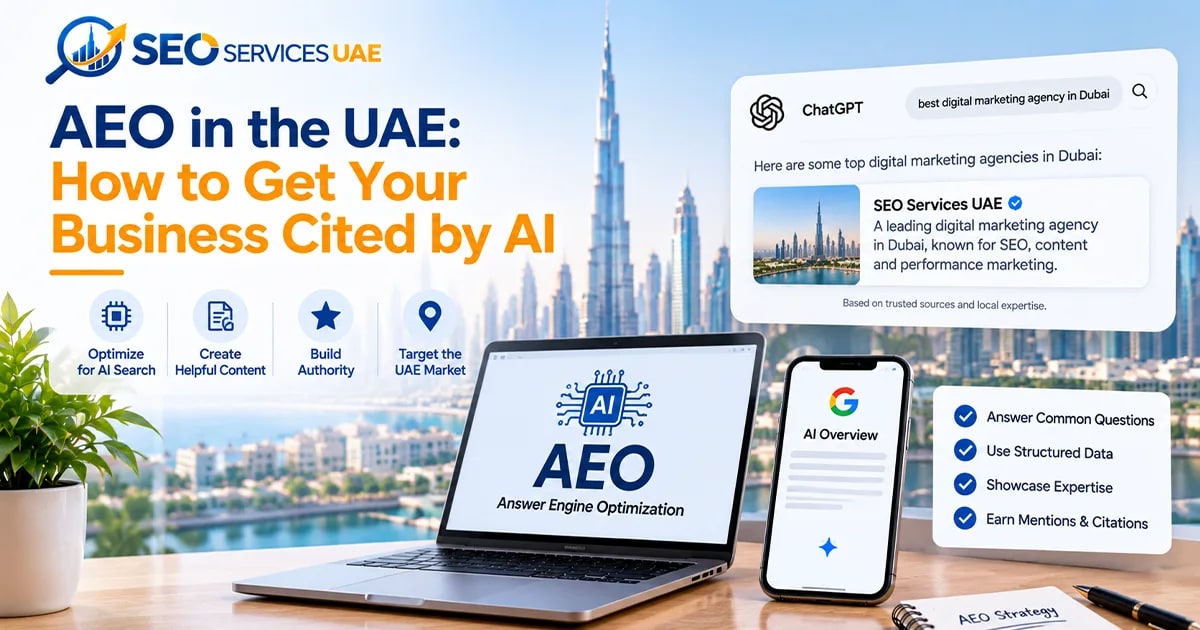
AEO in the UAE is making your business easy for AI tools like ChatGPT, Google AI Overviews and Perplexity to find, trust and quote. With the UAE leading the world in generative AI use, that means a consistent business identity, answer-first pages in English and Arabic, credible UAE media coverage and clean access for AI crawlers.
The first time a Dubai client asked me why ChatGPT recommended three competitors and not them, I assumed it was a ranking problem. Their site ranked well. The real issue was that almost nothing outside their own website described them clearly, and their best service page buried the price, the location and the answer under four paragraphs of brand story.
That pattern repeats across the UAE. Strong Google rankings, weak AI presence. Fixing it is what answer engine optimization actually means in practice: less about tricks for chatbots, more about making your business unambiguous, quotable and verifiable.
Legacy UAE SEO vs. AEO at a Glance
| Dimension | Legacy UAE SEO | Answer Engine Optimization |
|---|---|---|
| Ranking unit | A page ranking for a keyword | A business or person recognised as an entity and quoted in an answer |
| Content goal | Longer pages that cover keywords | Clear, answer-first sections with facts AI systems can lift accurately |
| Off-page signal | Backlink volume | Credible mentions in UAE media, reviews and community threads |
| Arabic strategy | Translated copy of the English site | Native Arabic and Gulf phrasing, matched facts in both languages |
| Technical focus | Crawlability for Googlebot | Crawlability for Googlebot plus search bots such as OAI-SearchBot and PerplexityBot |
| Primary KPI | Rankings and organic sessions | Citations, accuracy of AI answers, AI referral leads and branded search |
Why Traditional UAE Search Just Broke (And What Replaced It)
Look at the numbers. Microsoft's AI Economy Institute reported that 73.3% of the UAE's working-age population used generative AI in the second quarter of 2026, according to its September 2026 AI diffusion report, the highest rate in the world. Singapore was second at 64.3%. The global average was 18.8%. In plain terms, roughly three in four people your business serves in Dubai and Abu Dhabi already use these tools, about four times the world rate.
Google's own platforms have moved the same way. At I/O in May 2026, Google said AI Overviews had over 2.5 billion monthly users and AI Mode had passed 1 billion. That means a large share of "best clinic in JLT" or "Ejari renewal fees" searches now start with a generated answer, not ten blue links.
Here is the reality for clicks. Seer Interactive's April 2026 study of 5.47 million queries found that organic click-through rate fell from 3.82% to 2.36% when an AI Overview appeared (February 2026 data). The same study found that being cited inside the AI Overview delivered about 120% more organic clicks per impression than not being cited. Being cited still trailed results with no AI Overview at all by 38%.
That changes everything about how I report to clients. A page can hold position one and lose traffic, or hold position six and win leads because it's the source the answer quotes. The question is no longer only "where do we rank?" It's "what does the answer say about us, and does it link to us?"
This is where a specialised SEO agency in Dubai earns its keep: the difference between guessing at prompt outputs and building an entity footprint that AI systems quote consistently. Whoever does the work, the mechanics below don't change.

Under the Hood: How Answer Engines Retrieve, Score, and Cite UAE Brands
Most AI search tools use some form of retrieval-augmented generation, usually shortened to RAG. The model doesn't answer from memory alone. It searches an index, pulls a set of passages, then writes an answer from them and cites some of the sources.
Google describes a related technique called query fan-out, which its AI features guide defines as "a set of concurrent, related queries generated by the model". Ask "best family-friendly villa communities in Dubai under AED 4 million" and the system may quietly search for school access, service charges, price ranges and community reviews, then combine what it finds. Your page doesn't need to rank for the original question. It needs to be the clearest source for one of those smaller ones.
Retrieval works on chunks. A page is split into passages, and each passage is judged on its own. That's why a paragraph that only makes sense after reading the previous three rarely gets quoted. When I audit UAE sites, the most common extraction failures are:
- Key facts loaded by JavaScript after the page renders, so a simple fetch returns an empty shell.
- Prices, fees and locations hidden in images, PDFs or "contact us for a quote" forms.
- Answers buried under long brand introductions.
- Different facts on the English and Arabic versions of the same page.
Two terms get mixed up, so here's how I separate them. AEO is about live, search-grounded answers: being retrieved and cited when someone asks a question today. GEO (generative engine optimisation) is broader. It's about how models describe your brand in general, which depends on what has been written about you across the web over time. In practice the work overlaps heavily, and our guide to getting your Dubai business cited in AI Overviews and ChatGPT covers the citation side in more depth.

Answer Engine Optimization (AEO) in the UAE: The Four-Layer Execution Stack
I run AEO projects in four layers, in this order. Skipping the first layer to jump straight to schema is the most expensive mistake I see.
Layer 1: Entity Disambiguation and Knowledge Graph Anchoring
An entity is a thing a machine can identify without guessing: this company, at this address, run by these people, offering these services. If your trade licence says one name, your Google Business Profile another and your LinkedIn page a third, AI systems see three weak signals instead of one strong one.
- One legal name everywhere. Match the trading name on your Department of Economy and Tourism or free zone licence across your website footer, Google Business Profile, LinkedIn, Crunchbase and industry directories.
- Consistent facts. Address, phone, founding year, leadership names and core services should read the same on every profile.
- Wikidata where it's justified. If your company is genuinely notable, a well-sourced Wikidata item helps machines connect your profiles. Don't create one without independent sources, because it will be removed.
- Link it together. Use the sameAs property in your Organization markup to point to your official profiles.
I check this with a simple test: ask three AI tools "Who is [brand] and what do they do in Dubai?" and compare the answers with reality. Wrong founding dates, old addresses and outdated services almost always trace back to an old directory listing or a forgotten profile. Then give machines one page to trust. A plain About page with your legal name, licence type, founding year, leadership, locations and what you do (and don't do) becomes the reference that other profiles should match. I keep a single "brand facts" sheet for every client, and every new listing or press bio is copied from it. For local businesses, the same consistency rules apply to the map, which our UAE Map Pack guide covers step by step.
Layer 2: RAG-Ready Content Engineering and Extractable Formatting
Write the answer first. Under every question-style heading, put a direct answer of two or three sentences, then the detail. That's not about word counts. It's about making sure the first passage under the heading can stand alone if it's lifted into an answer.
Here's a typical rewrite. Before: "At our company, we believe every home deserves the very best care, and our passionate team has served the community for years." After: "Annual AC maintenance for a three-bedroom villa in Dubai costs AED 650 to AED 900 including VAT, covers four visits and takes about two hours per visit." The second version answers a real question, and it can be quoted without the paragraph around it.
Be careful not to overdo it. Google's guide warns against splitting content into tiny pieces just for AI, and says to make pages for your audience, not just for generative AI search. The goal is clarity, not fragments.
- Self-contained paragraphs. Name the subject in each paragraph ("Ejari renewal in Dubai costs…") instead of starting with "it" or "this".
- Real HTML tables. Comparisons, fee schedules and specifications belong in tables, not screenshots.
- Visible AED pricing. Ranges are fine. "Starting from AED 1,200, including VAT" is quotable. "Contact us" is not.
- Dates and sources. Show when facts were last checked, and link to the official source for regulations.
- First-hand detail. Google's guide asks for original content based on what you know. Your own process, photos and examples are what generic competitors can't copy.

Layer 3: Bilingual AEO Across English, Modern Standard Arabic, and Gulf Dialect
UAE users prompt in at least three registers. English is the default for many expats. Modern Standard Arabic suits formal and official topics. Gulf Arabic and transliterated hybrids show up in everyday searches. The same need often appears in both languages:
| English query | Arabic equivalent |
|---|---|
| Ejari renewal Dubai | تجديد ايجاري دبي |
| Off-plan villas Dubai Hills | فلل على الخارطة دبي هيلز |
| Best dental clinic in Dubai | أفضل عيادة أسنان في دبي |
On phones, people also mix the two, typing an English word with an Arabic one in the same query. Raw machine translation fails here because it translates words, not intent. A native editor will choose the term people actually use, keep legal terms accurate and match the tone of the market. Proper Arabic SEO is what makes the Arabic version a real source rather than a copy.
- Give each language its own URL with hreflang values such as en-AE and ar-AE pointing at each other, plus self-referencing canonicals.
- Keep facts in parity: the same prices, hours, licence numbers and dates in both languages.
- Mark up both versions with the same entity identifiers, so machines know they describe one business.
- Test prompts in Arabic as well as English, because answers often differ between them.
I've audited bilingual sites where the Arabic page showed last year's prices for months because nobody owned it. To an AI system, that's two conflicting sources from the same brand, and neither looks fully trustworthy.
Layer 4: Nested JSON-LD Schema and AI Crawler Governance
Start with an honest expectation. Google's AI guide says plainly that there's no special schema.org markup you need to add for AI features, and that Google Search doesn't use llms.txt files. Structured data still helps machines understand your entities and keeps you eligible for rich results, so I treat it as clarity, not as a citation switch.
A connected @graph block links your Organization, LocalBusiness, key people and services with IDs, so each piece references the others instead of floating alone:
{
  "@context": "https://schema.org",
  "@graph": [
    {
      "@type": "Organization",
      "@id": "https://example.ae/#org",
      "name": "Example Interiors LLC",
      "sameAs": [
        "https://www.linkedin.com/company/example-interiors"
      ]
    },
    {
      "@type": "LocalBusiness",
      "@id": "https://example.ae/#dubai",
      "parentOrganization": {
        "@id": "https://example.ae/#org"
      },
      "address": {
        "@type": "PostalAddress",
        "addressLocality": "Dubai",
        "addressCountry": "AE"
      }
    },
    {
      "@type": "Person",
      "@id": "https://example.ae/#founder",
      "name": "Founder Name",
      "worksFor": {
        "@id": "https://example.ae/#org"
      }
    },
    {
      "@type": "Service",
      "name": "Villa interior fit-out",
      "provider": {
        "@id": "https://example.ae/#org"
      },
      "areaServed": "Dubai"
    }
  ]
}
Every value must match the visible page. Then sort out crawler access, because this is where I most often find self-inflicted damage. OpenAI's documentation says sites that block OAI-SearchBot won't appear in ChatGPT search answers, while GPTBot is used for model training and each setting is independent. Perplexity says PerplexityBot surfaces sites in its search results and isn't used to train foundation models. Google says the Google-Extended token controls Gemini training and grounding and doesn't affect inclusion or ranking in Google Search.
User-agent: OAI-SearchBot
Allow: /

User-agent: PerplexityBot
Allow: /

User-agent: GPTBot
Disallow: /
That example allows search retrieval and blocks training. It's a business decision, not a default, so agree it with leadership. Then check rendering: if your product or service details only appear after client-side JavaScript runs, move them into server-rendered HTML or edge rendering. That fix sits squarely in technical SEO, and it often does more for AI visibility than any markup.

Off-Site Authority and the 84% Earned Media Rule in the Middle East
Here's the number that changes budgets. Muck Rack's May 2026 "What Is AI Reading?" analysis of more than 25 million links in ChatGPT, Claude and Gemini responses found that about 84% of citations come from earned media. Owned and paid content together made up about 16%, and paid or advertorial content just 0.3%.
In other words, what others publish about you matters more than what you publish about yourself. I've explained this to more than one UAE executive who wanted another hundred directory links: a handful of genuine mentions in respected regional outlets will do more for AI visibility than a pile of low-quality backlinks.
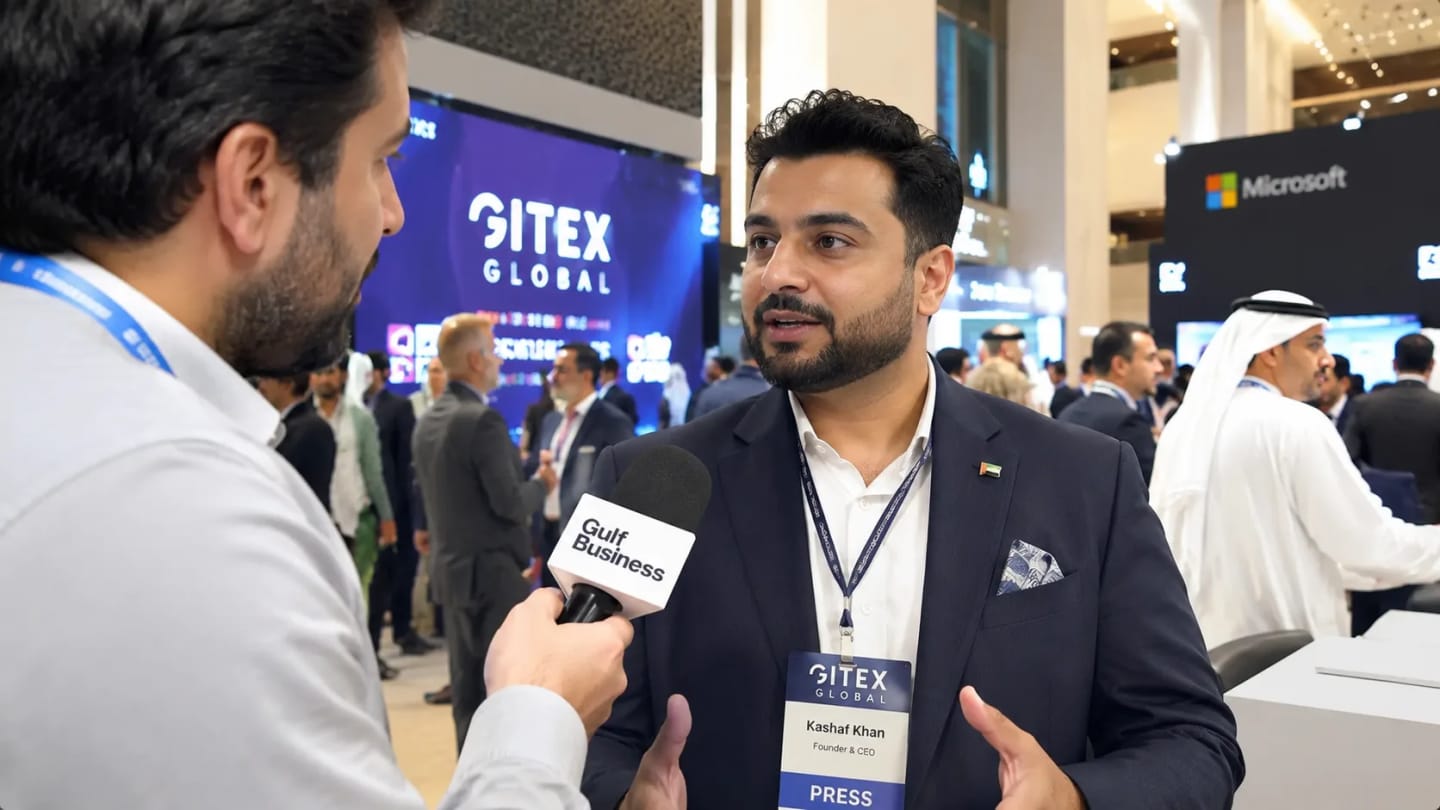
- Earn coverage in credible UAE outlets. Gulf News, Khaleej Times, The National, Arabian Business and Zawya all carry weight. Offer data, expert commentary or useful local research, not press releases about yourself.
- Get into honest comparison lists. "Best X in Dubai" roundups are often cited during fan-out. Earn a place with genuine reviews and clear differentiators. Don't pay for placements you can't disclose.
- Watch community sentiment. Threads on r/dubai and r/UAE, Quora answers and Trustpilot reviews feed many AI answers. Respond helpfully and openly as the brand, never with fake accounts.
- Don't ignore Arabic media. Coverage in Arabic-language outlets such as Al Khaleej, Al Bayan or Emarat Al Youm reaches a different audience and strengthens your Arabic entity signals.
- Build entity co-occurrence. Being mentioned alongside the topics and places you serve ("fit-out contractor in Dubai Hills") helps machines connect you to the right questions.
Reputation is part of this. A steady online reputation management routine keeps the sources AI systems read accurate and recent.
Vertical AEO Playbooks for High-Stakes UAE Sectors
Real Estate and Off-Plan Developers (Dubai and Abu Dhabi)
Property questions are fact-heavy, so publish the facts. For each project, give the developer, community, handover date, payment plan, unit types, price ranges and service charges per square foot in an HTML table. Show the advertising permit on listings: in Dubai, property ads need a marketing permit issued through the Land Department's Trakheesi system. Build community comparison pages that answer real questions about schools, commute times and service charges.
Our Abu Dhabi real estate case study shows what structured project data, area guides and regional press can do. Over 2025, the developer's non-branded top-10 keywords rose from 4 to 39, and the site picked up about 17,030 AI Overview impressions in Q4 2025 alone. It's one developer and self-reported, so treat it as an example. For brokerages and developers, this kind of verifiable project data is the core of property search visibility now.
E-Commerce and Omnichannel Retail
AI shopping answers favour stores with clean, current data. Keep AED prices, stock, delivery windows (same-day Dubai or Sharjah where you offer it), return rules and Tabby or Tamara instalment eligibility visible on product pages and consistent with your Google Merchant Center feed. Product and Offer markup should come from the same source as the visible price. Check the Merchant Center diagnostics weekly, because price mismatches between the feed and the page are one of the fastest ways to lose shopping visibility. Retail teams that treat this as part of e-commerce SEO rather than a separate AI project usually move faster.
Healthcare, Legal and Financial Services (YMYL)
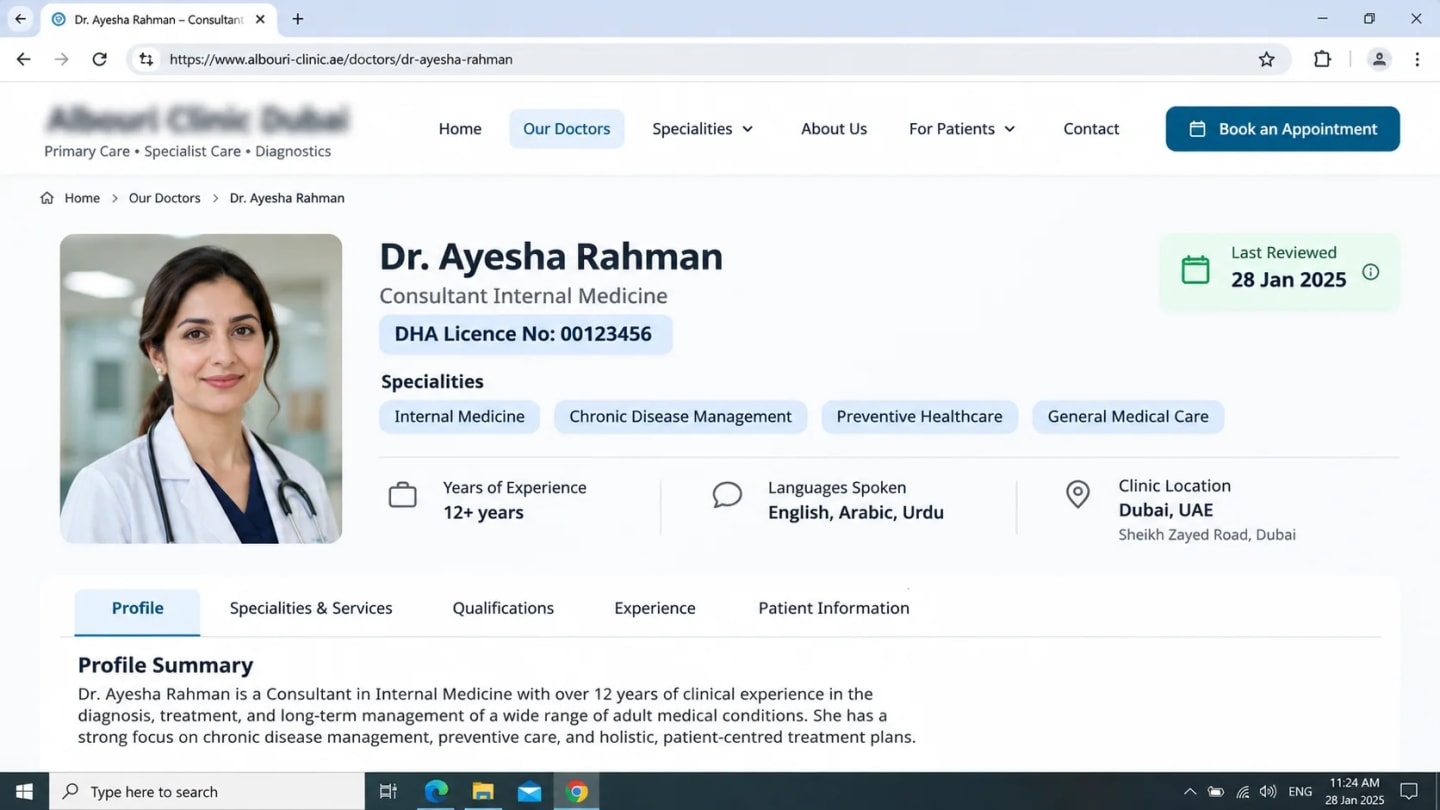
For sensitive topics, AI systems lean on trust signals. Show practitioner licences from DHA or DOH, named specialist authors with real bios, review dates and clear disclaimers. Financial providers should publish CBUAE-aligned disclosures and fees in readable HTML, not just PDFs. Our YMYL SEO guide for UAE banks covers the governance side in detail.
Measuring What Moves Revenue: The AEO Tracking Stack
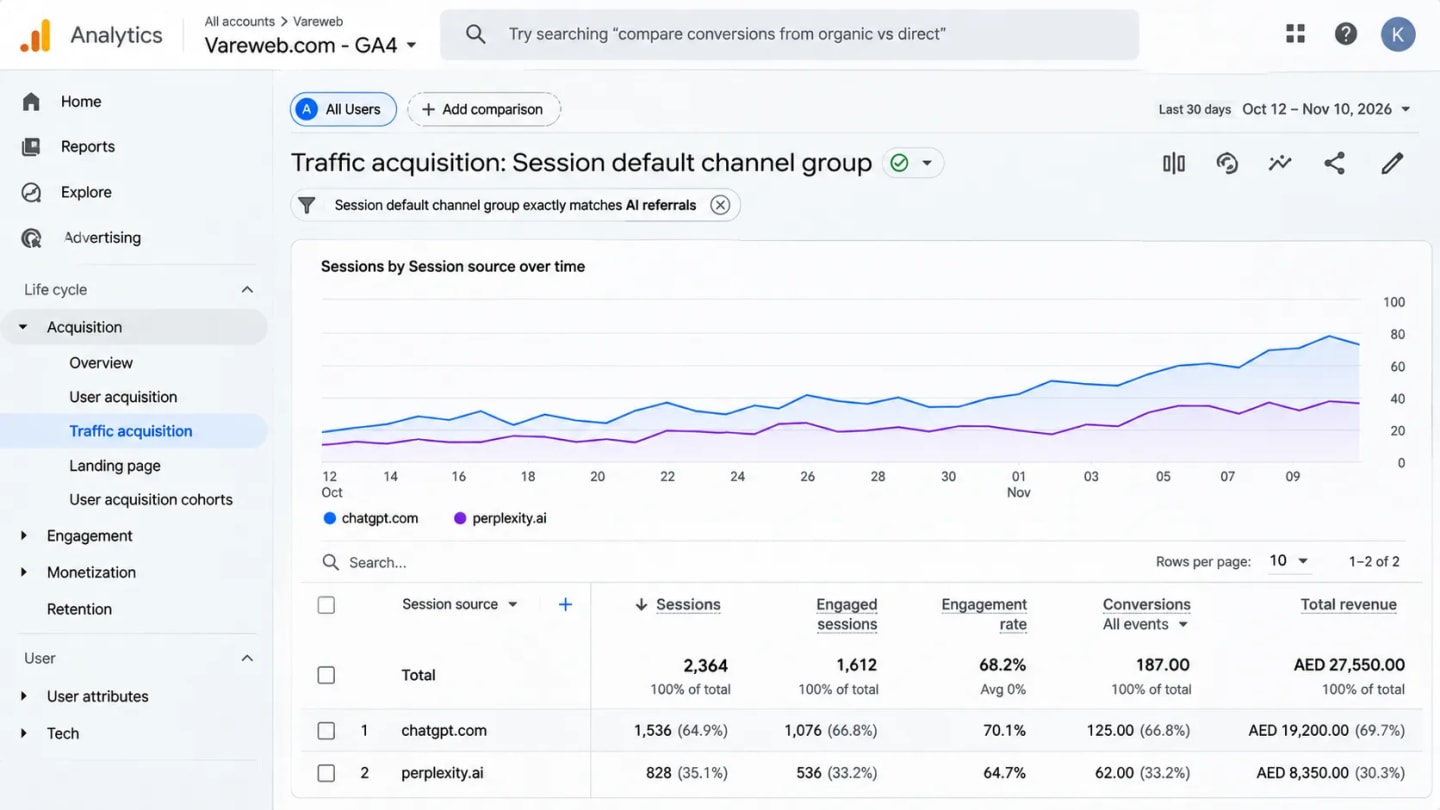
You can't manage what you don't separate. In GA4, create a custom channel group called "AI referrals" that matches sources such as chatgpt.com, perplexity.ai, gemini.google.com, claude.ai and copilot.microsoft.com, and place it above the default referral channel. Then build conversion reports for that channel. Expect the numbers to understate reality, because some AI traffic arrives without a referrer.
- Fixed-prompt audits. Pick 20 to 30 real customer questions in English and Arabic, run them monthly in ChatGPT, Perplexity and Google, and record whether you appear, what's said and which URL is cited.
- Share of model. Track how often you're mentioned compared with your top competitors across those prompts.
- Accuracy log. Note wrong prices, addresses or claims, and fix the source page or profile.
- Search Console signals. Watch branded search growth and impressions on long, question-style queries.
- Server logs. Track visits from OAI-SearchBot, PerplexityBot and Googlebot to see whether your key pages are being fetched.
Test from the right place. Many AI tools personalise by location and language, so run your audits with UAE settings and an Arabic interface for the Arabic prompts, and log which tool and mode you used. Results from a laptop in London won't match what a buyer in Abu Dhabi sees.
AI answers vary between runs, so look at trends across months, not a single screenshot. When a client sends me one prompt result in a panic, the first thing we do is rerun it five times.
Five Legacy SEO Habits That Will Get Your UAE Brand Erased by AI
- Hiding prices behind "Contact us for a quote". If you won't state a range, AI systems will quote a competitor who does.
- Writing 400-word intros before the answer. Retrieval rewards the passage that answers, not the one that warms up.
- Blocking every AI bot by default. Blocking OAI-SearchBot removes you from ChatGPT search answers. Decide bot by bot.
- Buying cheap PBN and Web 2.0 links. They add risk and little credibility. Earned regional coverage does far more.
- Publishing "By Admin" content in YMYL niches. Anonymous health, legal or finance content is hard for people or machines to trust.
FAQs
Does Answer Engine Optimization replace traditional SEO in the UAE?
No. Google's AI features draw on its search index, so crawlable, well-ranked pages still matter. AEO adds entity consistency, answer-first formatting, earned media and AI-specific tracking on top.
How long does it take for a Dubai business to start appearing in ChatGPT and Google AI Overviews?
Technical fixes such as crawler access and rendering can show results within weeks of the next crawl. Earned media and entity signals usually take several months to build.
Should I block GPTBot and OAI-SearchBot in my website's robots.txt file?
They do different jobs. OAI-SearchBot controls whether you appear in ChatGPT search answers, while GPTBot relates to model training. Many businesses allow the first and decide separately on the second.
Why does ChatGPT recommend my UAE competitors even when my website ranks #1 on Google?
AI answers lean heavily on third-party sources, and Muck Rack's May 2026 report puts earned media at about 84% of citations. If competitors are covered by credible outlets and you aren't, they'll be mentioned more often.
Do I need separate Arabic content to rank in AI search engines in the UAE?
If your customers search in Arabic, yes. Use native Arabic pages with hreflang and the same facts as the English version, rather than machine translation.
How do I track leads and sales coming from ChatGPT and Perplexity in Google Analytics 4?
Create a custom channel group for AI referral sources such as chatgpt.com and perplexity.ai, then report conversions for that channel. Expect some AI traffic to arrive without a referrer.
What is the single most effective schema markup for AEO?
There isn't a magic type. Google says no special schema is needed for its AI features, so start with accurate Organization and LocalBusiness markup that matches your visible content.
Can small and mid-sized UAE businesses compete with enterprise brands in AI Overviews?
Yes, especially on specific local questions. A clear, well-sourced page that answers a narrow query can be cited ahead of a big brand that only covers it broadly.
More articles you might like
 Local SEO
 Kashaf Khan
Eid Al Etihad Google Business Profile Checklist
Set Eid Al Etihad special hours, Offer posts and festive photos on your Google Business Profile before 2 December, without post rejections or suspensions.
 SEOKashaf Khan
YMYL SEO Guidelines for UAE Banks and Financial Institutions
Explore YMYL SEO guidelines for UAE banks and financial institutions to build trust, strengthen E-E-A-T, and improve search rankings.
 SEOKashaf Khan
11 SEO Tips To Prepare Your Store For White Friday 2026
Prepare your store for White Friday 2026 with 11 SEO tips to boost rankings, attract shoppers, and increase sales.