
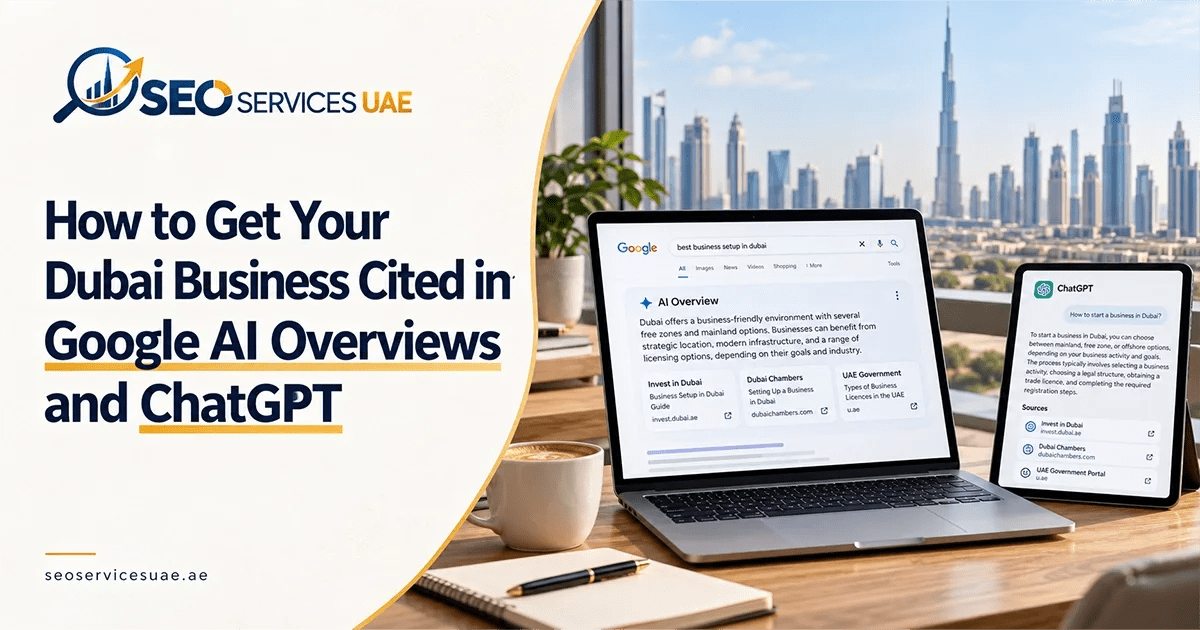
QUICK ANSWER
To get cited in Google AI Overviews and ChatGPT, stop optimizing pages for keywords and start optimizing your business as an entity. Answer engines cite brands they can identify with confidence: a consistent Knowledge Graph footprint, RAG-friendly answer-first content, robust LocalBusiness schema and mentions from trusted UAE sources. Keyword stuffing and generic backlinks add almost nothing to that picture.
Yalla, let's start with where Dubai search actually stands. Microsoft's Q2 2026 data puts the UAE first on its national leaderboard, with 73.3% of the working-age population using generative AI. Your customers are already asking ChatGPT, Gemini and Google's AI Mode for the best clinic, broker or rental company in the city. Then they act on the answer.
Most Dubai businesses are still optimizing for the algorithm of 2023. I've watched a real estate brand with strong listings and a healthy backlink profile vanish from AI answers about its own communities. Nothing was wrong with its rankings. Its business details disagreed across four platforms, and the machines couldn't tell which version was real.
This guide is the playbook I use to fix that, built on five years of SEO content work across industries. It covers eight strategies, the tools to measure them and the habits worth dropping. Every statistic comes from a 2026 source you can open yourself. Where I describe client patterns, I keep them qualitative on purpose: no invented case studies, no made-up percentages.
Quick Overview: How to Get Cited in AI Overviews and ChatGPT
| # | Strategy | What the AI needs to see | Start here this week |
|---|---|---|---|
| 1 | Entity optimization | One consistent, verifiable identity | Align name, address and phone across your site, Google Business Profile and directories |
| 2 | RAG formatting | Self-contained, extractable passages | Rewrite your top 10 pages as question, two-sentence answer, detail |
| 3 | Digital PR and E-E-A-T | Third-party corroboration | Pitch one data-backed comment to a UAE outlet; log unlinked mentions |
| 4 | Conversational intent | Pages that answer the full question | List 30 real customer questions in English and Arabic |
| 5 | Technical AEO | Crawlable pages with nested data | Check robots.txt, firewall rules and schema validation |
| 6 | Reviews and UGC | Fresh, specific third-party opinion | Reply to every review with service and area details |
| 7 | Real-time data | Current, machine-readable facts | Sync price and availability; date every pricing table |
| 8 | Multi-modal SEO | Images and video it can interpret | Original photos, descriptive alt text, video transcripts |
The Shift from Search Engines to Answer Engines in the UAE
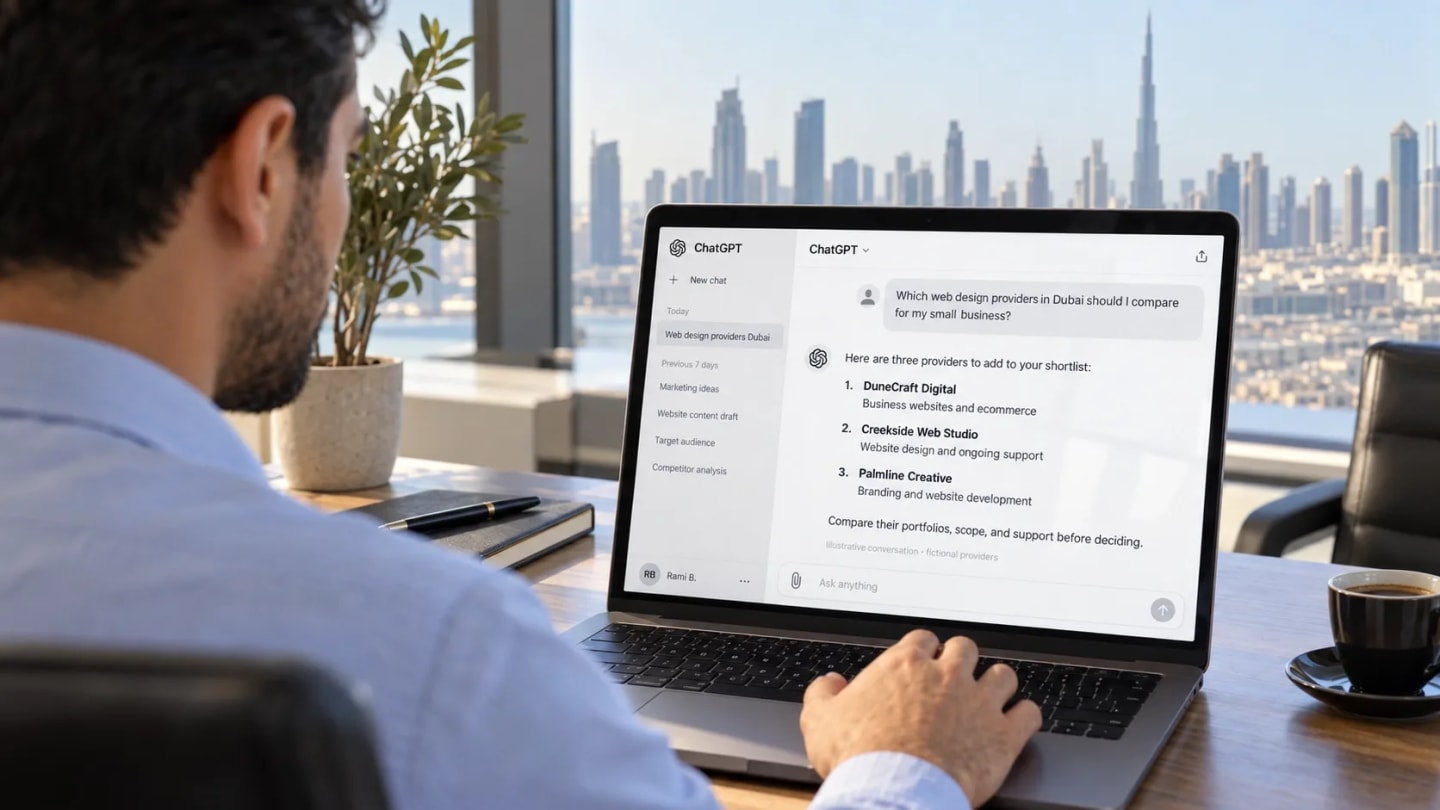
A traditional results page hands you a list and lets you judge. An AI Overview does the judging. It retrieves passages from several sources, writes one synthesized answer and names a few brands inside it. Google said at I/O 2026 that AI Overviews now has over 2.5 billion monthly active users, and that AI Mode passed one billion in its first year. This isn't a beta you can wait out.
The click impact is measurable. SparkToro's 2026 study of Similarweb clickstream data found that 68.01% of U.S. Google searches ended without a click between January and April 2026, up from 60.45% in 2024. That's American data, and as far as I know no comparable public UAE dataset exists, so treat it as directional. Still, a market where nearly three in four working-age residents use AI tools isn't going to behave more conservatively.
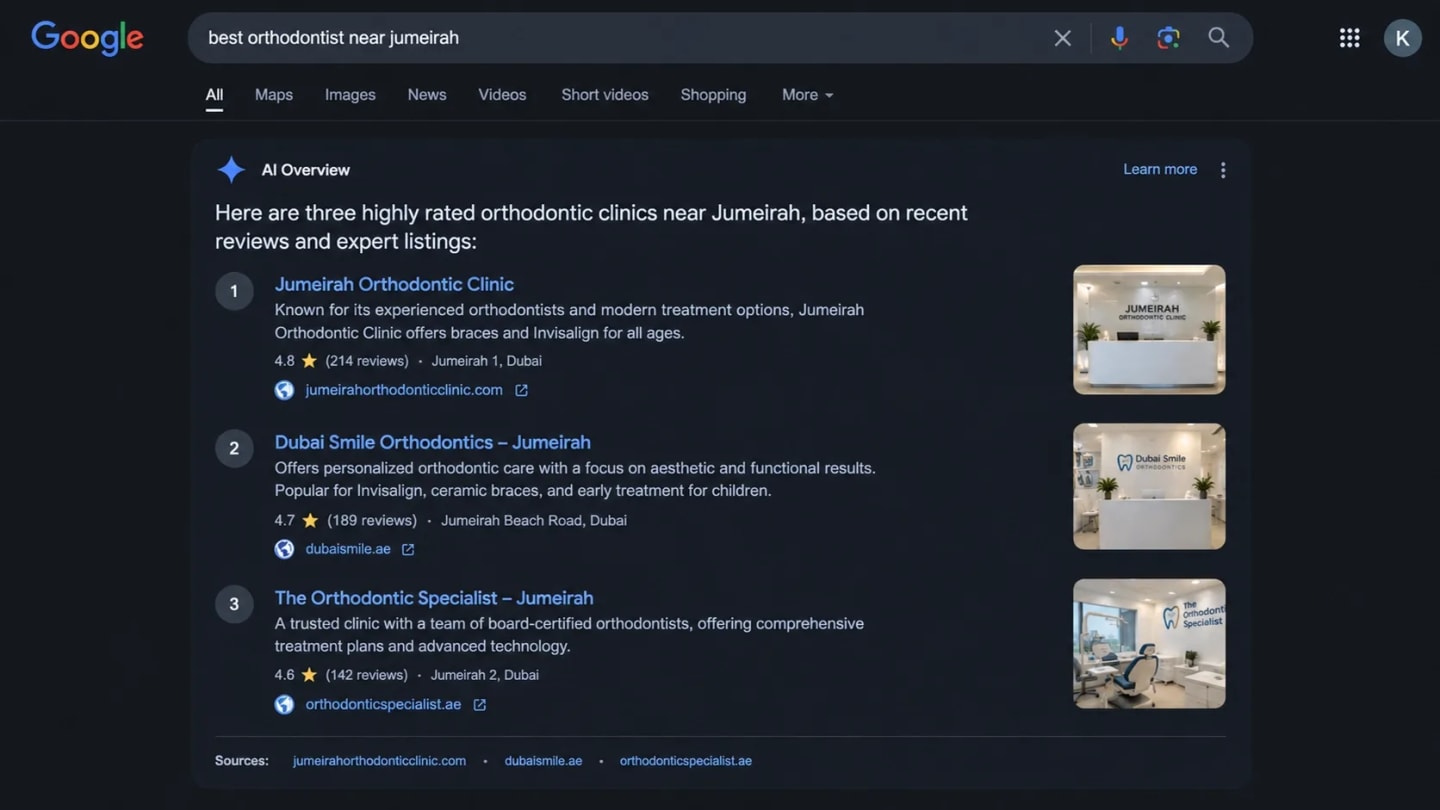
Here's the reality for a Dubai SME. Someone asks for the best orthodontist near Jumeirah, gets a shortlist of three and books through WhatsApp without opening a website. If you weren't on that shortlist, you never entered the race, and your analytics will never show the loss.
That's why working with a specialized SEO agency in Dubai is critical to making sure your technical infrastructure, entity data and content are ready for answer engines. Whoever you choose should be able to explain how they measure citations, not just positions.
How to Get Cited in AI Overviews and ChatGPT
Strategy 1: Entity Optimization and the Knowledge Graph (Dubai Context)
Search engines used to match strings. Answer engines reason about things. A knowledge graph stores entities, such as your clinic, your founder and your address, along with the relationships between them. If your brand isn't clearly defined as an entity in your niche, ChatGPT simply won't recommend you. It will name the competitor it can describe with confidence.
Start with the unglamorous work:
- Fix NAP consistency. Your trade name, address, phone number and category must match on your website, your Google Business Profile, Apple Maps, Bing Places and UAE directories. Google's guidelines say to present your business exactly as it appears on your signage and branding.
- Build a real identity page. State who you are, what you do, which emirates you serve, who runs the business and your licence details. For clinics and brokerages, add regulator references where the rules require them.
- Declare bilingual names. Use the alternateName property in schema for the Arabic and English versions of your brand, so both resolve to one entity.
- Connect the dots with sameAs. Link your Organization schema to your LinkedIn page, YouTube channel and Business Profile.
- Treat Wikidata carefully. Wikidata is an open knowledge base that many pipelines use as a reference layer. Entries for businesses that don't meet notability standards get deleted, so earn coverage first (Strategy 3), then document it.
Hypothetical scenario: A Dubai Marina dental clinic appears as "Al Noor Dental Clinic" on its website, "Al Noor Dental Center LLC" on Maps and "Alnoor Dentistry" on a directory. A patient sees one clinic. A retrieval system sees three uncertain candidates, and uncertainty is exactly what makes a model recommend someone else. Pick one canonical record, put it in a spreadsheet and correct your top twenty listings against it.

Strategy 2: Formatting Content for RAG (Retrieval-Augmented Generation)
Here is exactly how we format content for Retrieval-Augmented Generation. First, the plain-English version. RAG means the model doesn't answer from memory alone. It retrieves relevant passages from an index, then writes its answer grounded in them. The consequence is blunt: you aren't competing as a page anymore. You're competing as a passage.
The format that survives extraction is simple:
- Question as the heading. Use the exact phrasing a customer would use, in a real H2 or H3.
- Direct answer in two sentences. State the answer, the number and the condition immediately.
- Detailed elaboration. Put the caveats, steps, exceptions and proof underneath.
Here's exactly what that looks like on a Dubai car rental page:
|
EXAMPLE ANSWER BLOCK How much does a luxury car rental cost in Dubai per day? Luxury SUV rentals at Marina Prestige Rentals start from AED 900 per day including 5% VAT, and sports cars start from AED 1,800 per day. Every rental needs a refundable security deposit from AED 2,000, unless you choose the no-deposit plan. Rates rise during the Dubai Shopping Festival and the December peak. The no-deposit plan adds AED 75 per day and includes zero-excess insurance. Delivery to Palm Jumeirah, Downtown Dubai and Dubai International Airport is free on rentals of three days or more. |
Then the mechanics. Write each answer block so it makes sense if lifted out of the page. Name the entity instead of writing "we" or "it". Put units, currency and dates next to every number. Use real semantic HTML: proper heading levels, lists and tables with header cells, because comparison data is far easier to extract from a table than from a paragraph.
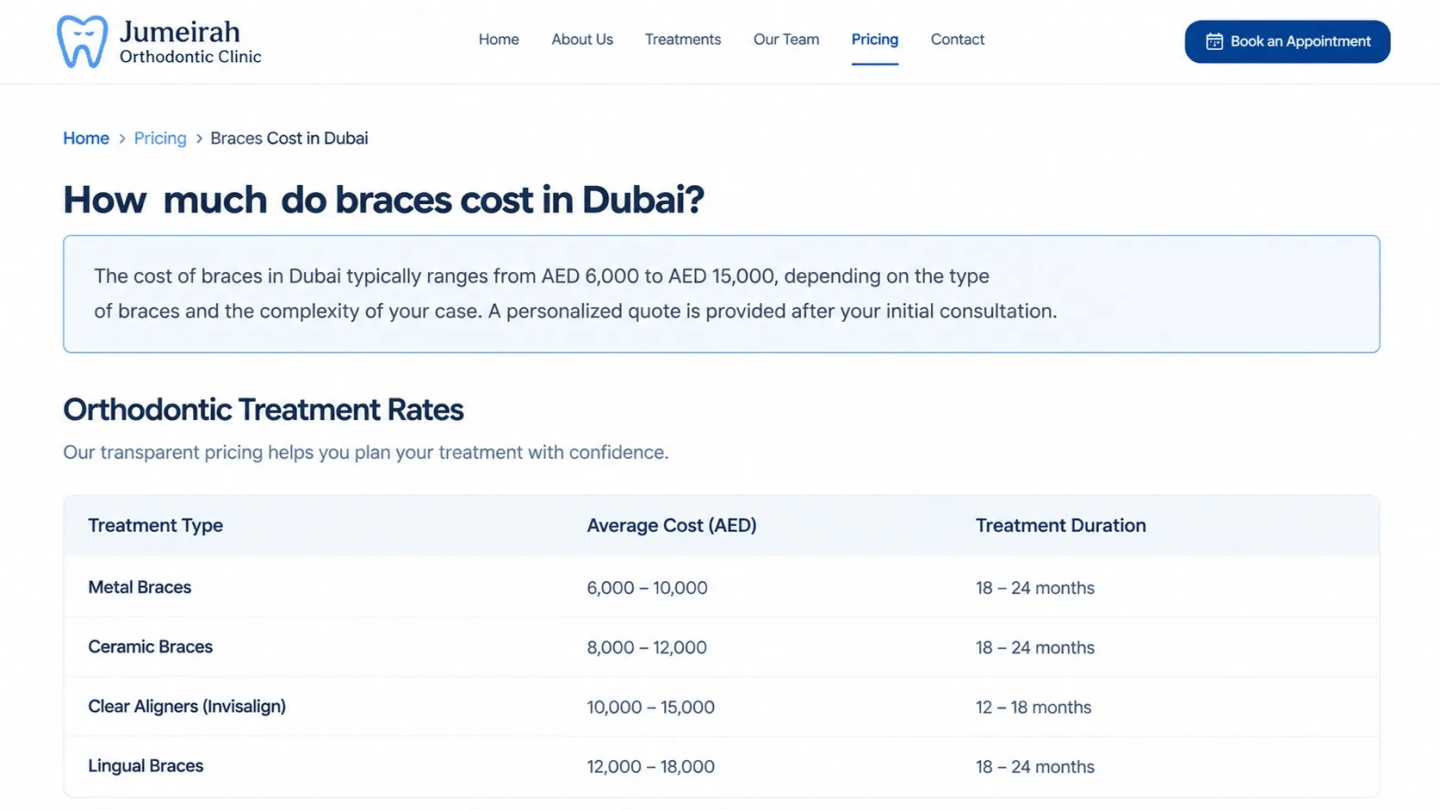
Structure alone won't win. Answer engines reward information gain, which means something the other ten pages don't say. Original pricing ranges, first-hand process photos, your own anonymised enquiry patterns, a licence-specific detail. This is the core of answer engine optimization, and it's where generic "write good content" advice falls apart.
Strategy 3: Digital PR, Brand Mentions and E-E-A-T in the Middle East
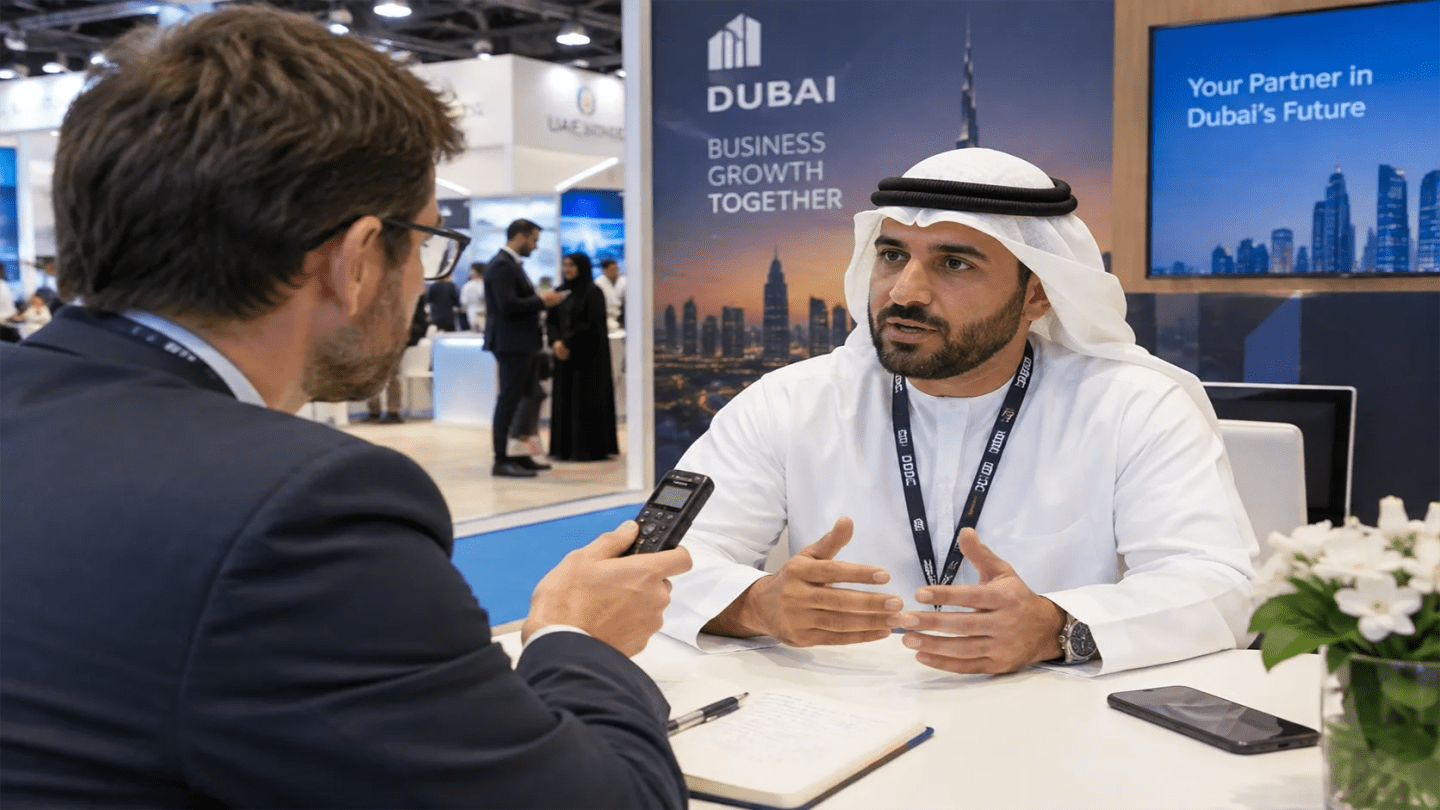
I once had to explain to a UAE CEO why one mention in a trusted local publication matters more to an LLM than fifty low-quality backlinks. The answer is corroboration. Answer engines are cautious, and they cross-check. When Khaleej Times, Gulf News or a respected trade body describes your brand the way your own site does, the claim becomes safer to repeat.
The mechanism is co-occurrence: your brand name keeps appearing near your category and your location in sources the system already trusts. Links help, but unlinked mentions still count as signal, so stop ignoring them. Nobody outside these companies knows the exact weighting, and I won't pretend otherwise. What I've seen in prompt testing is consistent, though. Brands with third-party descriptions get named more often than brands that only describe themselves.
In Gulf business culture, الثقة (thiqa, trust) is built through relationships and reputation. Answer engines end up mirroring that. Routes that work:
- Offer journalists expert commentary backed by your own data, such as a quarterly read on enquiry trends in your sector.
- Get listed by chambers of commerce, industry associations and licensing bodies that publish member directories.
- Speak at UAE industry events, and make sure the organizer's page names you and your company in full.
- Search your brand monthly for unlinked mentions, and ask for a link only when it's natural.
E-E-A-T carries extra weight in regulated sectors. Health content falls under Google's YMYL standards, which is why healthcare SEO starts with doctor bylines, licence details and medical review dates before any keyword work. Google's guidance on creating helpful, reliable content is worth rereading through that lens: show who wrote it, how they know and why anyone should trust them.
Strategy 4: Conversational Long-Tail and Semantic Intent Mapping
Nobody types “Dubai car rental” into an assistant. They ask: what is the best luxury car rental in Dubai for a weekend with no deposit? Or, in Arabic, أفضل شركة تأجير سيارات فاخرة في دبي بدون وديعة. Google says AI Mode divides your question into subtopics and searches for each one simultaneously. Your page has to answer the sub-questions, not just the headline.
For that weekend rental, the hidden sub-questions are deposit policy, mileage limits, insurance excess, delivery to Palm Jumeirah or Dubai Marina, Salik toll charges, minimum age and what a tourist licence needs. A page that answers all seven becomes the natural source. A page that says “luxury cars, best prices” answers none. For fleets, this logic is the backbone of automotive SEO, where each vehicle and policy gets its own answer-ready section.
Build your question map in three moves:
- Mine your real language. WhatsApp chats, sales call notes and support emails beat any keyword tool.
- Pull Search Console queries of six words or more, plus People Also Ask boxes and threads on r/dubai.
- Tag each question by intent (informational, comparison, local or transactional), then build a hub page with a focused answer block per question.
Language matters more than most teams admit. Gulf Arabic differs from Modern Standard Arabic, and customers mix both, plus English, inside one sentence. Research each language separately and write natively. That's the difference between a translated page and real Arabic SEO.
Strategy 5: Technical AEO (Nested Schema and AI Crawlability)
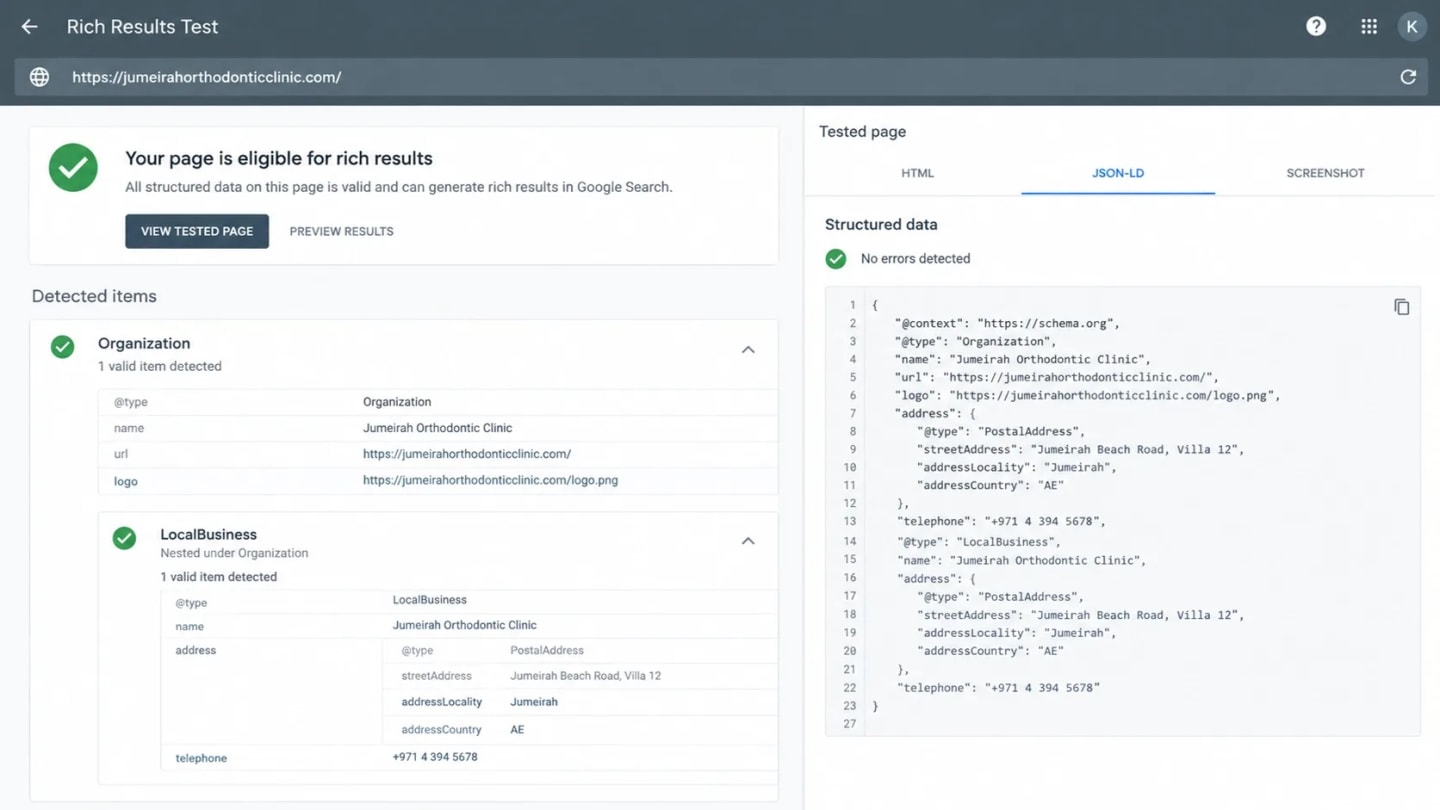
Basic LocalBusiness markup is table stakes. What separates cited brands is a connected graph: an Organization that owns a LocalBusiness, which offers Services, backed by an FAQPage and Articles that name real authors. Use the most specific subtype available, such as Dentist, AutoRental or RealEstateAgent, following the schema.org LocalBusiness hierarchy and Google's local business structured data guidance.
|
{ "@context": "https://schema.org", "@graph": [ { "@type": "Organization", "@id": "https://example.ae/#org", "name": "Example Dental Clinic", "sameAs": ["https://www.linkedin.com/company/example"] }, { "@type": "Dentist", "@id": "https://example.ae/#clinic", "parentOrganization": { "@id": "https://example.ae/#org" }, "areaServed": { "@type": "City", "name": "Dubai" }, "priceRange": "AED 150-AED 900", "makesOffer": { "@type": "Offer", "itemOffered": { "@type": "Service", "name": "Dental implants" } } } ] } |
Next, crawl access, where I see the most expensive mistakes. The rules differ by platform, and a lot of published advice gets them wrong:
- Google: AI Overviews and AI Mode are part of Search, so txt directives for Googlebot are the control. Google-Extended doesn't affect inclusion in Search and isn't a ranking signal, so allowing or blocking it doesn't change your AI Overview eligibility.
- Search Console: Google has introduced a generative AI control that lets site owners opt out of its AI Search features. Check whether it's available to you, and confirm nobody on your team switched it off.
- OpenAI: OpenAI's crawler documentation separates three agents. OAI-SearchBot decides whether you can appear in ChatGPT search answers, so allow it. GPTBot covers model training, which is a business decision. ChatGPT-User handles user-initiated fetches, isn't used to decide search inclusion, and OpenAI notes robots.txt rules may not apply to it.
- Your firewall: Cloudflare rules, security plugins and rate limits quietly challenge unfamiliar bots. OpenAI recommends allowing its published IP ranges for OAI-SearchBot, so check your server logs, not just your robots.txt.
Finally, rendering. As a working assumption, treat server-rendered HTML as the only safe bet, because several AI crawlers don't execute JavaScript reliably. Keep answer content in the initial DOM instead of behind client-side fetches, and keep LCP and INP healthy. If that sounds like a job for a proper technical SEO audit, it is.
Strategy 6: Leveraging Reviews and User-Generated Content as LLM Raw Material
When a query is opinion-shaped, like “best family hotel in Dubai Marina”, answer engines lean on what other people said. In my prompt testing, citations for those queries regularly point to review pages and forum threads rather than brand sites. Your reputation on Google Maps, TripAdvisor, Reddit and local community forums is raw material for the synthesis.
Play it straight:
- Ask happy customers for detailed reviews that name the service and the area, but never script them or offer incentives. Fake reviews violate platform policies and get you suppressed.
- Reply to every review with specifics: the treatment, the vehicle, the neighborhood. Your replies become extra descriptive text attached to your entity.
- Join community threads as a named human, disclose your affiliation and answer the question fully. Drive-by link drops get removed and remembered.
- For hotels and restaurants, review velocity and response quality are core to hospitality SEO.
Strategy 7: Feeding Real-Time Data via Feeds and Google Merchant Center
Models prefer facts they can verify, and stale facts are a liability. If an online store connects price and availability through Google Merchant Center, that data reaches Google's shopping surfaces in a structured, current form, while a competitor's static page may lag by weeks. I won't promise that any feed guarantees a citation. I will say that mismatched or outdated data guarantees you're an unsafe source.
The requirements sit in Google's product data specification, and Google expects price and availability in your feed to match your landing page. In the UAE, show prices in AED and state whether they include 5% VAT. Update feeds before Ramadan, White Friday and the Dubai Shopping Festival, not after. For Shopify, Magento and WooCommerce stores, that plumbing is a core part of ecommerce SEO.
Service businesses have no product feed, but the principle holds. Publish pricing tables labelled "from AED X" with a visible last-updated date, mirror that date in dateModified, and keep availability language consistent between your site and your Business Profile. For hotels and rentals, connect the booking engine so availability isn't a screenshot from last season.

Strategy 8: Multi-Modal SEO (Optimizing Visuals for AI Analysis)
AI systems now read images and watch video. Google Lens, AI Mode and multimodal assistants can interpret a photo of your showroom, so what's inside the image matters as much as the caption.
- Use original photography. Real photos of your fleet, clinic or property carry experience signals that stock images can't.
- Name and describe files properly. A file called burj-view-suite-dubai-marina.webp beats IMG_4402.jpg. Write alt text that describes what's visible, in English and Arabic on the matching pages, and follow Google's image guidance.
- Never bury facts in pixels. Prices or opening hours baked into a graphic are invisible to text retrieval. Put them in HTML.
- Give video a text twin. Publish a full transcript, timestamped chapters and VideoObject markup, so a model can quote the relevant minute.
Good alt text: "Silver Range Rover parked outside the Dubai Marina rental branch at sunset." Bad alt text: "luxury car rental Dubai cheap best car hire." One describes an image. The other describes an SEO habit from 2016.

The "Old SEO" Habits You Must Drop Immediately
Time to be brutal. These tactics don't just fail with answer engines. They actively muddy your identity.
- Keyword-stuffing local modifiers. "Best plumber Dubai cheap Dubai plumber near me" reads as spam to people and as a noisy passage to a retriever. Write one clear sentence instead.
- Publishing 50 thin pages, one per Dubai neighborhood. Swapping "Marina" for "JLT" in a template is doorway-page territory, and it dilutes your entity. Build a handful of genuinely different area pages with local proof: parking access, building names, typical pricing. That's how good real estate SEO in Dubai area guides earn their place.
- Buying thousands of low-tier Web 2.0 backlinks. The hard truth is that one accurate mention in a trusted UAE outlet does more for your entity than five hundred links from throwaway blogs.
- Mass-producing generic AI filler. If a page adds nothing the top ten results don't already say, retrieval systems have no reason to prefer it.
- Reporting only on rankings. A position-one ranking that gets no click is a vanity metric now. Track citations and leads.
How to Monitor Your AI Search Visibility and Citations
You can't fix what you can't see, and AI visibility is messy to measure. Here's the stack I'd build.
1. Referral traffic in GA4
Create a custom channel group called AI Assistants. Add a rule where Source matches a regex such as chatgpt.com|perplexity.ai|claude.ai|gemini.google.com|copilot.microsoft.com. Then compare sessions and key events from that channel against organic. Treat the numbers as a floor, because many AI answers send no click and some visits arrive as direct.

2. Prompt testing and AI tracking tools
Build a sheet of 25 to 30 commercial prompts in English and Arabic, such as “best real estate agency for off-plan apartments in Business Bay”. Run them monthly across ChatGPT, Gemini or AI Mode, Perplexity, Claude and Copilot, three times each because answers vary. Record whether you were mentioned, cited and described accurately, and which competitors appeared. Tools such as ZipTie and GeoRanker automate part of this. Trial them with your Arabic prompts first, since language coverage differs.
3. Google Search Console
Watch for long-tail, question-style queries where impressions rise while clicks stay flat. That pattern often signals AI Overview exposure. Google has said it's rolling out new Search Console insights on how pages appear in generative AI features, so check whether they've reached your property.
Report four numbers monthly: the share of test prompts that name you, mention accuracy, branded search trend and qualified leads from calls and WhatsApp.
FAQs
Do I need to optimize differently for ChatGPT versus Google AI Overviews?
The foundations are shared: a clear entity, answer-first content and clean schema. The crawl layer differs, though. Google draws on Googlebot and its Search index, while ChatGPT search depends on OAI-SearchBot access, so check both.
Will AI Overviews steal all my website traffic?
No, but informational clicks are shrinking, and the 2026 SparkToro data shows the direction. Shift your goals to citations, calls and WhatsApp enquiries, and protect the transactional pages that still earn clicks.
How long does it take to become a recognized entity by AI?
Cleaning up name, address and schema data can register within weeks once pages are recrawled. Consistent citations on competitive queries usually take months of corroboration. Anyone quoting a fixed timeline is guessing.
Is traditional keyword research dead in the UAE?
No, it has changed jobs. Volume data still sizes demand, but the real work is mapping full questions and intents in English, Arabic and mixed-language searches.
Should I block AI crawlers from scraping my Dubai business website?
Separate training from search. Allow Googlebot and OAI-SearchBot if you want to be cited, and treat GPTBot or Google-Extended as a business decision about training. Blocking training bots won't remove you from AI Overviews, but blocking search bots will remove you from ChatGPT search answers.
Can I pay to be featured in ChatGPT's answers?
Not in the organic answer. OpenAI's own documentation describes ads on ChatGPT, but those are labelled placements, and availability varies by market. Anyone selling guaranteed organic placement is selling fiction.
What is the most important technical change I need for Answer Engine Optimization?
Make sure the pages that answer your customers' questions are server-rendered, crawlable by Googlebot and OAI-SearchBot, and carry accurate nested schema that matches the visible content. If you fix one thing first, fix access.
Do I need Arabic content to be cited for Arabic prompts?
Yes, and it must be written natively rather than machine-translated. Test your Arabic prompts monthly, because English visibility doesn't carry over automatically.
More articles you might like
 Local SEO
 Kashaf Khan
Eid Al Etihad Google Business Profile Checklist
Set Eid Al Etihad special hours, Offer posts and festive photos on your Google Business Profile before 2 December, without post rejections or suspensions.
 AEOKashaf Khan
AEO in the UAE: How to Get Your Business Cited by AI
Learn how UAE businesses get cited by ChatGPT, Google AI Overviews and Perplexity: entity setup, Arabic AEO, schema, AI crawler rules and tracking.
 SEOKashaf Khan
YMYL SEO Guidelines for UAE Banks and Financial Institutions
Explore YMYL SEO guidelines for UAE banks and financial institutions to build trust, strengthen E-E-A-T, and improve search rankings.