
QUICK ANSWER
A verified Google Business Profile won't rank you in Dubai or Abu Dhabi anymore. The local grid is crowded with keyword-stuffed names, ghost listings and fake reviews, so winning the 3-pack in 2026 takes clean entity data that matches your trade licence and Makani number, steady spam reporting, bilingual English and Gulf Arabic content, a real review engine, and local data structured well enough for AI assistants and Apple Maps to read.
Most Dubai business owners treat their Google Business Profile like a form they filled in once. Then a competitor two streets away changes its name to "Best Cheap Car Rental Dubai Marina" and takes the top spot overnight. I've watched that happen in car rental, clinics, salons and real estate, and the owner's first reaction is always the same: we didn't change anything. That's exactly the problem.
Map Pack ranking in the UAE is operational work. It sits across your licence documents, your front desk, your website and your review habits, and it needs someone watching it every week. That's the reality of local SEO here, and it's very different from the generic checklists written for other markets.

The 2026 UAE Local Search Reality
Look at the data. BrightLocal's 2026 survey of US consumers found that 97% read reviews for local businesses, and 68% will only use a business rated 4 stars or higher, up from 55% a year earlier. Another 31% now want 4.5 stars or more. It's US data, but the behaviour matches what I see in Dubai: the comparison happens on the map, before anyone visits your website.
The platforms are shifting too. In the same survey, the share of consumers using Google for reviews and recommendations fell from 83% to 71%, while AI tools such as ChatGPT jumped from 6% to 45% and Apple Maps from 14% to 27%. Google is still the biggest source by far, but it isn't the only one anymore. Your data has to be right everywhere a customer might ask.
Spam is the other half of the picture. Google says it blocked or removed over 292 million policy-violating reviews in 2025, removed over 13 million fake Business Profiles and blocked 79 million inaccurate edits. Those are global numbers, and they tell you how much bad data is fighting for the same space as your listing.
When you're dealing with competitors keyword-stuffing their names in Business Bay, partnering with a hands-on SEO agency in Dubai is often the fastest way to audit the grid and reclaim your rankings. Whoever does the work, it has to be continuous.
Summary Table: 8-Phase Local SEO Execution Plan
| Phase | Technical execution | Main risk | KPI to watch |
|---|---|---|---|
| 1. Entity setup | Name, address and phone match licence, Ejari and Makani | Suspension, re-verification | Verification status |
| 2. Category architecture | Most specific primary category, few real secondaries | Wrong searches, edits flagged | Discovery searches |
| 3. Map spam fighting | Evidence-led Redressal Form reports | Fake competitors outrank you | Spam listings removed |
| 4. Bilingual intent | Arabic services, Posts and website pages | Missing Arabic searches | Arabic query impressions |
| 5. Review velocity | Steady asks, fast personal replies | Rating below 4 stars | Rating, review recency |
| 6. AEO structuring | AED prices, services, LocalBusiness schema | AI tools quote wrong data | Accuracy of AI answers |
| 7. Geo-grid tracking | Block-level rank grids per area | False sense of ranking | Average grid position |
| 8. Local hubs and NAP-W | Area pages, consistent citations | Conflicting business data | Areas ranking in the pack |
Local SEO in the UAE: The Complete Map Pack Guide
1. Flawless Entity Setup (DED Licenses, Ejari, and Makani Numbers)
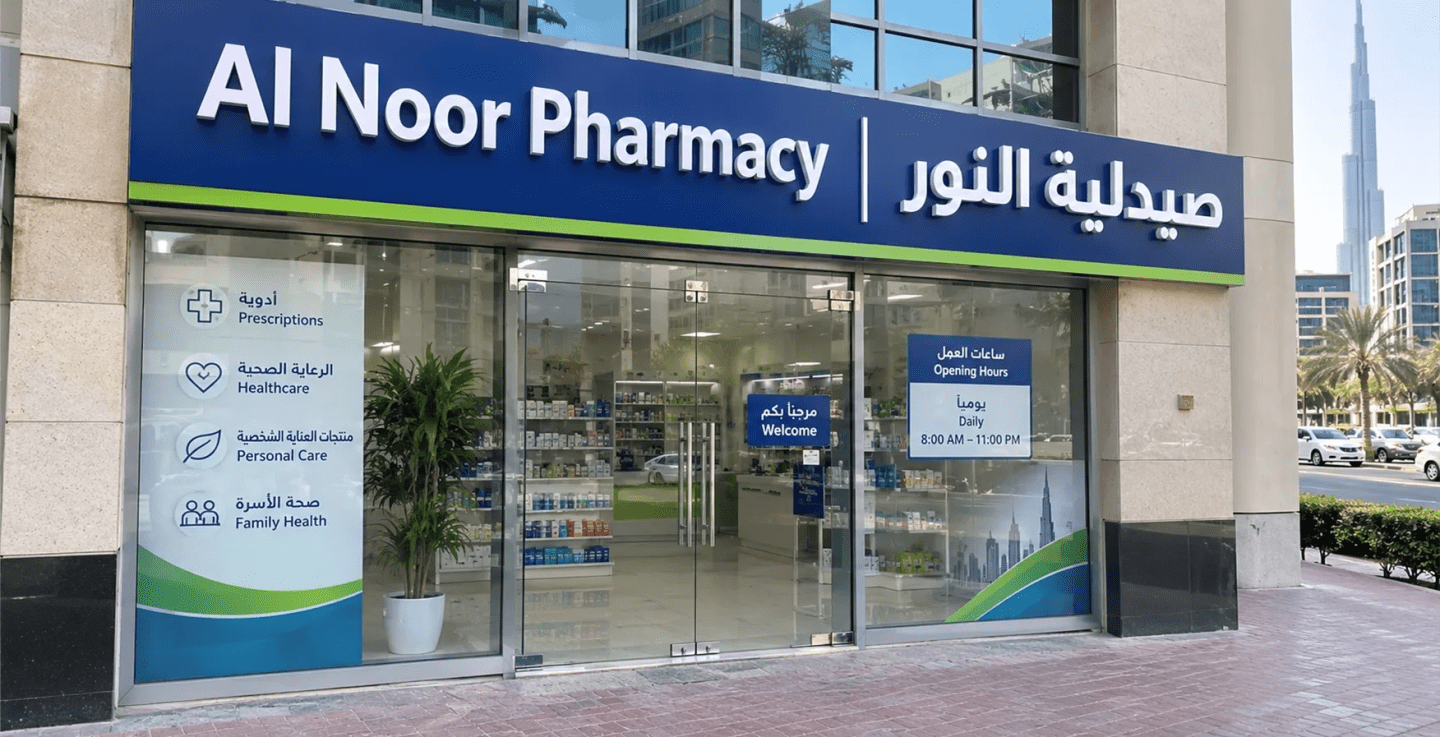
Most suspensions I've untangled in Dubai started with a mismatch. The trade licence (رخصة تجارية) says one name, the shop sign says another, and the profile says a third with "Dubai" stuck on the end. Pick the legal trading name and use it everywhere: Department of Economy and Tourism licence, Ejari tenancy contract, utility bills, signage and the profile.
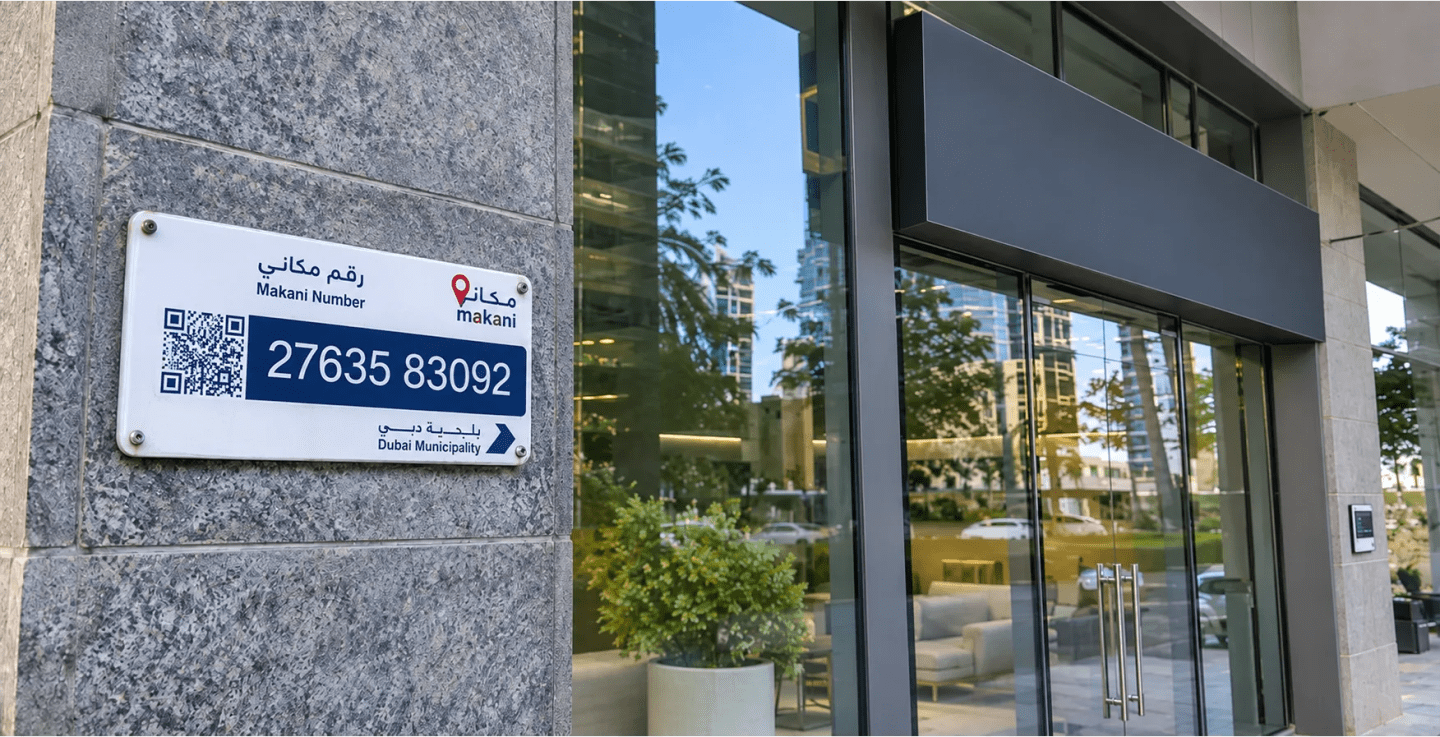
Then fix the location. A Makani number is the 10-digit code on the plate at a Dubai building entrance, and it pinpoints that entrance. Use it to place your map pin on the actual door, not the middle of the tower, and put it on your website contact page beside the full address. Google doesn't publish a Makani field, but a correct pin and consistent address are exactly what a reviewer checks.
Write the address the way people navigate here. Dubai addresses rarely use postcodes, so lead with the building name, then street, community and emirate, and keep a P.O. Box out of the street address. If you share a tower with fifty other companies, add the floor or unit in the second address line. I've seen pins drift to the wrong side of Sheikh Zayed Road because two buildings had similar names, and the fix was simply a clearer address and a re-dropped pin.
Prepare for video verification before you need it. Google's rules say the video must be captured live, unedited and at least 30 seconds, showing street signs or nearby landmarks, your business name on a permanent sign, and proof of management such as opening a till or a staff-only area. I tell clients to rehearse it once. A shaky, cut-off video is the most common reason I see verification stall.
2. Primary Category Architecture and GBP Attributes
Your primary category does most of the heavy lifting. Google says plainly that the categories you select affect your local ranking, that you should choose the most specific option available, and that editing categories may trigger re-verification. So, a dental clinic picks "Dental clinic", not "Medical clinic", and a car rental firm picks "Car rental agency", not "Transportation service".
Audit competitors before you decide. Tools like PlePer or the GMB Everywhere browser extension show which categories the top three in your area use. Add secondary categories only for real departments, never for every service. Then fill in attributes, services and products in full, because those are the details people actually filter on. Our Google Business Profile guide for Dubai walks through the full setup.
Stop changing your category every time rankings dip. I've seen profiles bounce between categories for months, losing ground each time and inviting extra checks. Pick the right one, then work on everything else. I regularly see clinics pick a broad category because it sounds bigger. Switching to the specific one, and leaving it alone, usually does more than months of posting.
3. Aggressive Map Spam Remediation (Killing Competitor Ghost Listings)
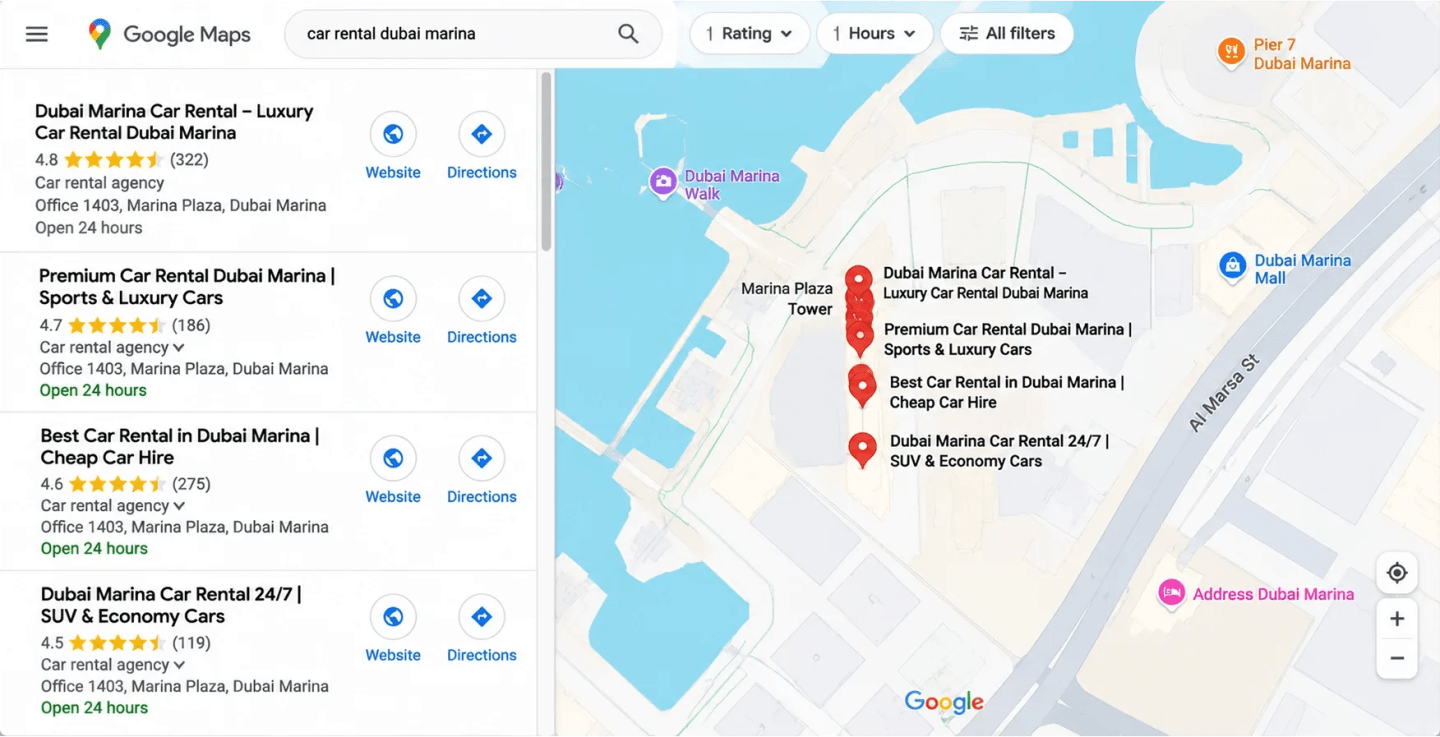
Here is the reality: in dense areas like Business Bay, Dubai Marina and Al Barsha, some of the profiles above you shouldn't exist. Common patterns include names stuffed with keywords, several "branches" at one virtual office, and listings with no signage at the pinned address. Google's guidelines say your name should reflect your business's real-world name and that unnecessary information isn't permitted.
For single issues, use "Suggest an edit" on the listing. For patterns, Google's Business Redressal Complaint Form takes Maps URLs, a quote of the misleading content and your explanation. Here's how I run it:
- Document first: screenshot each listing, the street view at the pin, and the real signage, with dates.
- Check the real name: compare the profile with the signage, website and any licence details on display, and note where the trading name differs.
- Batch by pattern: group listings with the same phone number, website or virtual-office address into one report.
- Quote exactly: copy the stuffed name word for word, and explain how it misleads customers.
- Track and resubmit: Google doesn't confirm outcomes, so recheck the grid two to four weeks later.
Set expectations with the owner. Some reports work within weeks, some need resubmitting with better evidence, and some patterns come back under new names. The work is never one report. It's a monthly sweep of your top keywords in your top areas, with a log of what you reported and what changed.
Keep it factual. You're reporting misleading information, not a competitor you dislike. Google's 2026 update also added review-extortion protection and owner email alerts for important edits, which helps legitimate businesses spot tampering with their own profiles faster.
4. Bilingual Optimization (Bridging English and Gulf Arabic Intent)
If your profile only speaks English, you're missing a real share of searches. An expat in JLT types "dentist near me", while a local family in Deira may search for the nearest pharmacy (أقرب صيدلية) or a nearby restaurant (مطعم قريب مني). Those are different queries with different expectations, even when the business is the same. Modern Standard Arabic suits formal descriptions, but Gulf speakers often search in everyday terms, so test both against your Search Console data before choosing wording.
Keep one profile per location, because Google's guidelines allow one profile per business and duplicates create conflicts. Bridge the languages around it instead:
- Write service descriptions that include the Arabic terms customers actually use, checked by a native Gulf Arabic speaker.
- Alternate Google Posts between English and Arabic, and match the offer in both.
- Reply to Arabic reviews in Arabic, and to English reviews in English.
- Build matching Arabic landing pages on your website with proper hreflang, so the profile's website link lands people in the right language.
Machine translation is where brand confusion starts. Proper Arabic SEO uses native phrasing for car rental (تأجير سيارات), clinics and services, so the Arabic version reads like your brand, not a translation of it.
5. Review Velocity and Automated Sentiment Control
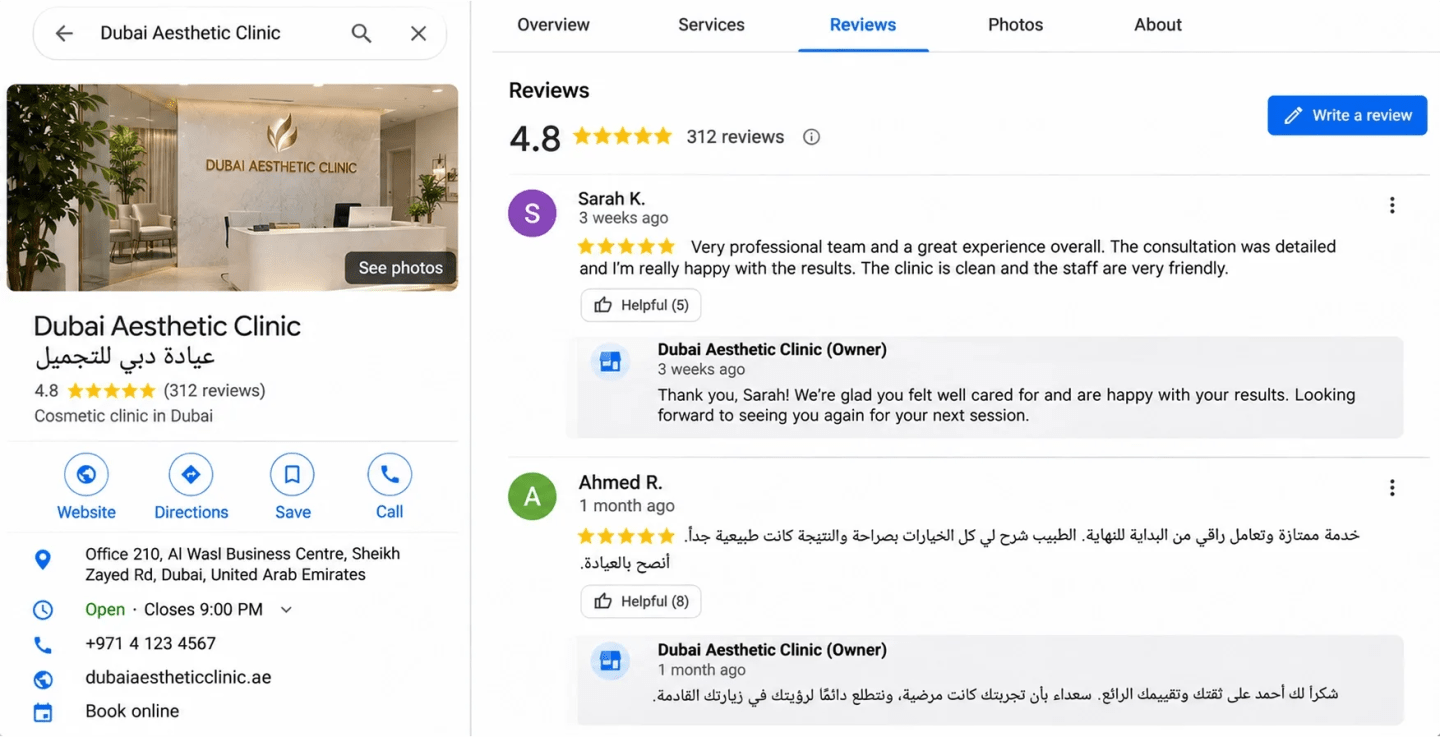
Your reputation is your ranking. Google says more reviews and positive ratings can help your local ranking, and that there's no way to pay for a better one. BrightLocal's numbers add urgency: 74% of consumers only consider reviews from the last three months, so a strong rating from 2024 doesn't protect you now.
- Ask steadily, not in bursts. A QR code at the counter, a WhatsApp message after the job, a card with the receipt. Sudden spikes look suspicious.
- Never pay or filter. Offering rewards or asking only happy customers breaks Google's policies.
- Prompt for specifics. "Which branch did you visit, and what did we do for you?" invites natural mentions of the service and area.
- Reply like a person. 89% of consumers expect owners to respond, 50% are put off by templated replies, and 19% now expect a same-day response.
- Close the loop. Send negative themes to operations every week, because a recurring complaint about parking or wait times won't be fixed by replies alone.
Apple Maps matters more than most UAE businesses think. Claim your listing through Apple Business Connect, keep hours and photos current, and watch ratings there too. A good online reputation management routine covers every platform where customers leave feedback, not just Google.
6. Structuring Local Entity Data for AI Overviews (AEO)
AI assistants answer local questions from whatever clean data they can find. Google launched Ask Maps, a Gemini-powered assistant inside Maps, in the US and India in March 2026. It isn't live in the UAE yet, but it shows where local search is heading.
Get ready now. Fill the Products and Services sections with exact AED prices where you can, plain descriptions and real photos. On your website, add LocalBusiness markup with name, address, phone, URL, opening hours and coordinates. Google's LocalBusiness documentation asks for latitude and longitude with at least five decimal places, and supports seasonal hours with validFrom and validThrough dates.
{
  "@context": "https://schema.org",
  "@type": "Dentist",
  "name": "Example Dental Clinic",
  "address": {
    "@type": "PostalAddress",
    "streetAddress": "Bay Square, Building 5",
    "addressLocality": "Business Bay, Dubai",
    "addressCountry": "AE"
  },
  "geo": {
    "@type": "GeoCoordinates",
    "latitude": 25.18512,
    "longitude": 55.27891
  },
  "telephone": "+971-4-000-0000",
  "openingHoursSpecification": [
    {
      "@type": "OpeningHoursSpecification",
      "dayOfWeek": [
        "Monday",
        "Tuesday",
        "Wednesday",
        "Thursday",
        "Friday"
      ],
      "opens": "09:00",
      "closes": "21:00"
    }
  ]
}
Every value must match the profile. When I test AI assistants with local prompts, wrong answers almost always trace back to an outdated directory or an old website page. Test it monthly: ask ChatGPT and Google a few realistic questions, such as "open now dentist in Business Bay" or "car rental with no deposit in Dubai Marina", and note what they say about you. Fix the source, not the prompt. Our guide to getting cited in AI Overviews and ChatGPT covers the wider entity work.
7. Geo-Grid Tracking and Neighborhood-Level Proximity SEO
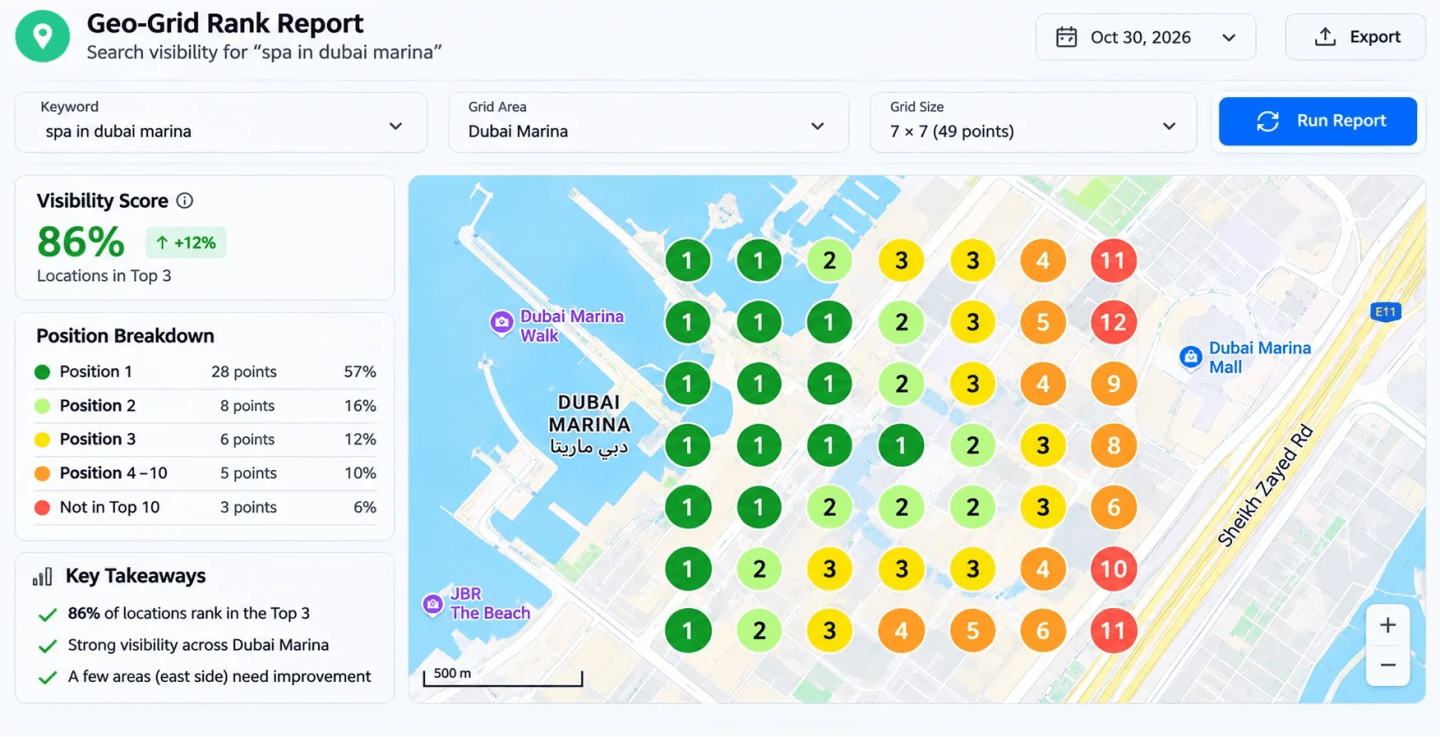
Ranking in Jumeirah doesn't mean you rank in Deira. Google ranks local results on relevance, prominence and distance from the person searching, so your position changes every few hundred metres. A single rank check from your office tells you almost nothing.
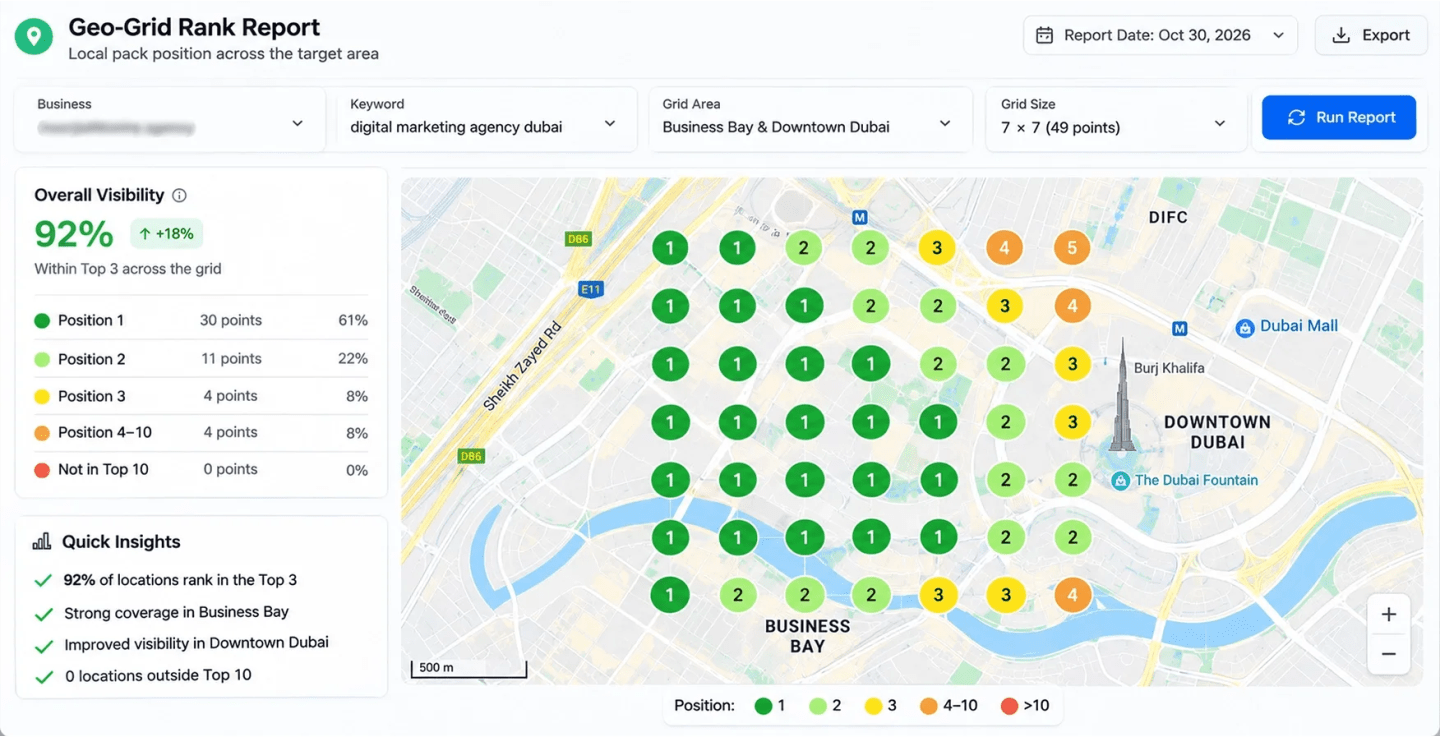
Use a geo-grid tracker such as BrightLocal or Local Viking. Set a grid over each target area (for example 7x7 points across Business Bay), track your main keywords weekly, and compare against the top three competitors. Watch for patterns: strong in the centre and weak at the edges is normal; weak around your own pin usually means a relevance or category problem, not distance. I share grid snapshots with clients monthly, side by side with the previous month, because owners understand a map turning green far faster than a rank table.
Be honest about what you can't change. A business in Deira will struggle to rank for "near me" searches made in Dubai Marina, because proximity is built into the system. You can still win area-specific searches like "car rental Dubai Marina" with strong relevance, reviews and a dedicated page.
8. Local Hubs, City-Specific Landing Pages, and NAP-W Consistency
Your website backs up your profile. Build one location page per branch, with a URL like /dubai/business-bay/, and give it real content: address, Makani number, opening hours, an embedded map, parking notes and directions from landmarks such as the Dubai Mall or the nearest metro station. Add LocalBusiness markup and link the page from the profile.
For service-area businesses, build area pages only where you genuinely serve customers, with unique detail for each. In our Dubai automotive local SEO case study, dedicated area pages, a rebuilt profile and cleaner citations took the number of Dubai areas where the garage appeared in the Map Pack from 2 to 9 over 2025. It's one business, so treat it as an example, not a promise.
Then lock down NAP-W consistency: name, address, phone and website identical across directories, social profiles, Apple Maps, Bing Places and your own site. Keep one spreadsheet of every listing with its login owner, because old directory accounts created by a former employee are a classic source of conflicting phone numbers. Multi-location brands in clinics and retail need a single source of truth for this, which is a big part of healthcare SEO for groups with several branches.

The "Old Local SEO" Habits You Must Drop Immediately
- Stuffing keywords into your business name. It breaks Google's guidelines and invites reports from competitors.
- Setting it and forgetting it. Profiles get edited by users, hijacked by spammers and outranked by new entrants.
- Buying reviews or asking in bursts. Sudden spikes and paid reviews are exactly what Google's systems look for.
- Ignoring Apple Maps and AI tools. Customers ask in more places than Google now.
- Fake area pages. Thin pages for places you don't serve add nothing and can hurt trust.
- Tracking one keyword from the office. Grids show the truth; a single rank check doesn't.
- Templated review replies. Customers notice, and half of them say it puts them off.
FAQs
How long does it take to rank in the Dubai local 3-pack in 2026?
For a new, well-set-up profile in a moderate category, expect steady gains over three to six months. Competitive categories in dense areas like Business Bay take longer, and spam can slow you down until it's reported.
What is a Makani number and why does Google care about it?
It's the 10-digit code that identifies a Dubai building entrance. Google doesn't use it as a field, but it helps you set an exact pin and a consistent address, which supports verification and distance accuracy.
How do I report a UAE competitor who is keyword-stuffing their GBP name?
Suggest an edit for a single listing, or use Google's Business Redressal Complaint Form for patterns. Include Maps URLs, the exact stuffed name and evidence of the real business name.
Do I need separate Google Business Profiles for English and Arabic?
No. Google's guidelines allow one profile per business, so keep one and add Arabic through services, Posts, review replies and your website pages.
Why did my Google Business Profile get suspended after a minor edit?
Changes to the name, address or category can trigger a review, especially if they don't match your licence or signage. Revert to your real-world details, then follow Google's reinstatement process with documents.
How do Apple Maps and ChatGPT impact my local foot traffic?
More customers use them to find businesses, so wrong hours or prices there cost visits. Claim Apple Business Connect and keep your website and profiles consistent so AI tools quote correct data.
What is geo-grid tracking and why is basic rank tracking useless for local SEO?
Geo-grid tracking checks your rank at many points across an area. Local results change with the searcher's location, so a single check can't show where you really appear.
Can I rank in Dubai Marina if my physical office is in Deira?
For "near me" searches made in the Marina, it's very hard, because distance matters. You can still compete for searches that name the area, with a strong page, reviews and relevant content.
More articles you might like
 Local SEO
 Kashaf Khan
Eid Al Etihad Google Business Profile Checklist
Set Eid Al Etihad special hours, Offer posts and festive photos on your Google Business Profile before 2 December, without post rejections or suspensions.
 Local SEOKashaf Khan
Google Business Profile Suspended? How to Recover
Learn how to recover a suspended Google Business Profile, fix policy violations, and restore your business listing.
 Local SEOKashaf Khan
How to Optimize Your Google Business Profile for the Dubai Market
Learn how to optimize your Google Business Profile for better local rankings and more customers in Dubai.