
The Technical SEO Checklist for Large-Scale E-Commerce Brands in the UAE
- 17 min read

QUICK ANSWER
The most critical technical SEO priority for large-scale UAE e-commerce is controlling what search engines crawl and index: catastrophic crawl waste, botched ERP and logistics integrations, and slow team publishing hurt revenue more than thin content does. To outrank competitors in 2026, move beyond basic tags to strict edge caching for headless builds, data-driven hreflang across GCC storefronts, and SEO governance that aligns development sprints with marketing goals and Answer Engine Optimization.
Most enterprise brands in Dubai blindly trust their platform's native SEO settings, not realizing their faceted navigation just minted a couple of million crawlable URLs. In a USD 12.30 billion UAE e-commerce market, that's an expensive blind spot, and it's the core problem in serious e-commerce SEO at scale. In most UAE audits I run, the first thing I notice in Search Console is crawl requests landing on URLs nobody ever meant to exist.
The 2026 UAE E-Commerce Platform Landscape (Market Share and Technical Realities)
By store count, AfterShip detects 44.81K UAE online stores: Shopify has 18.81K (41.99%), WooCommerce 16.16K (36.05%), custom carts 3.19K, Magento 602 and Odoo 364. By revenue, IDC reports Shopify captured 21.8% of worldwide digital commerce applications revenue in 2025, up from 19.5%. Treat that as a global, all-merchant-size signal of Shopify's momentum, not a UAE enterprise number.
By traffic tier, the Web Almanac shows Salesforce Commerce Cloud second, SAP Commerce Cloud third and Magento fourth among the top 10,000 sites, with Shopify first in the top 100,000. That fits the region: SFCC and Magento anchor the top tier, Shopify keeps climbing, and nobody publishes a clean GCC revenue split by platform. Headless builds hide their fingerprints, so custom and Odoo stacks are undercounted.
WooCommerce holds a large share of mid-market stores but passes Core Web Vitals on only 35% of mobile origins in the Almanac, which fits what I see: it breaks at scale without server-side caching and database tuning. The Almanac notes Salla is strong in Saudi Arabia, so your KSA storefront may run a different platform.
Here's the point: every platform has a distinct footprint in Dubai, and every single one needs custom technical intervention at scale. When you're dealing with a botched multi-regional migration, bringing in a specialized SEO agency in UAE is the only way to align your development sprints with GCC search realities.

Quick Overview: 9-Phase Enterprise SEO Checklist
| Phase | Biggest risk | Core control | KPI to watch |
|---|---|---|---|
| 1. Crawl budget | Filter and parameter URL explosion | Robots, noindex and canonical used for the right jobs | Share of crawls on canonical URLs |
| 2. Localization | Broken hreflang, IP redirects | Reciprocal language-region clusters | Return-tag errors |
| 3. API integrations | 200-to-404 flips from ERP syncs | Documented SEO contracts | Status-code volatility |
| 4. Headless and edge | Incomplete HTML, cache leaks | SSR, controlled cache keys | Source vs rendered HTML parity |
| 5. AEO | Schema and feed contradictions | PIM-generated markup, validation | Price and stock mismatches |
| 6. Internal search | Index poisoning by bots | Noindex, rate limits, sanitizing | Indexed search URLs |
| 7. Core Web Vitals | Script and font bloat | Budgets and script owners | LCP, INP, CLS by template |
| 8. Governance | Developer-ticket bottlenecks | RACI, release gates, content model | Time to publish a page |
| 9. Conversion UX | Checkout and address friction | Local payment and RTL testing | Organic landing-page conversion |
The Complete Technical SEO Checklist for Large-Scale E-commerce Brands in the UAE
Phase 1: Crawl Budget Control and Faceted Navigation Traps
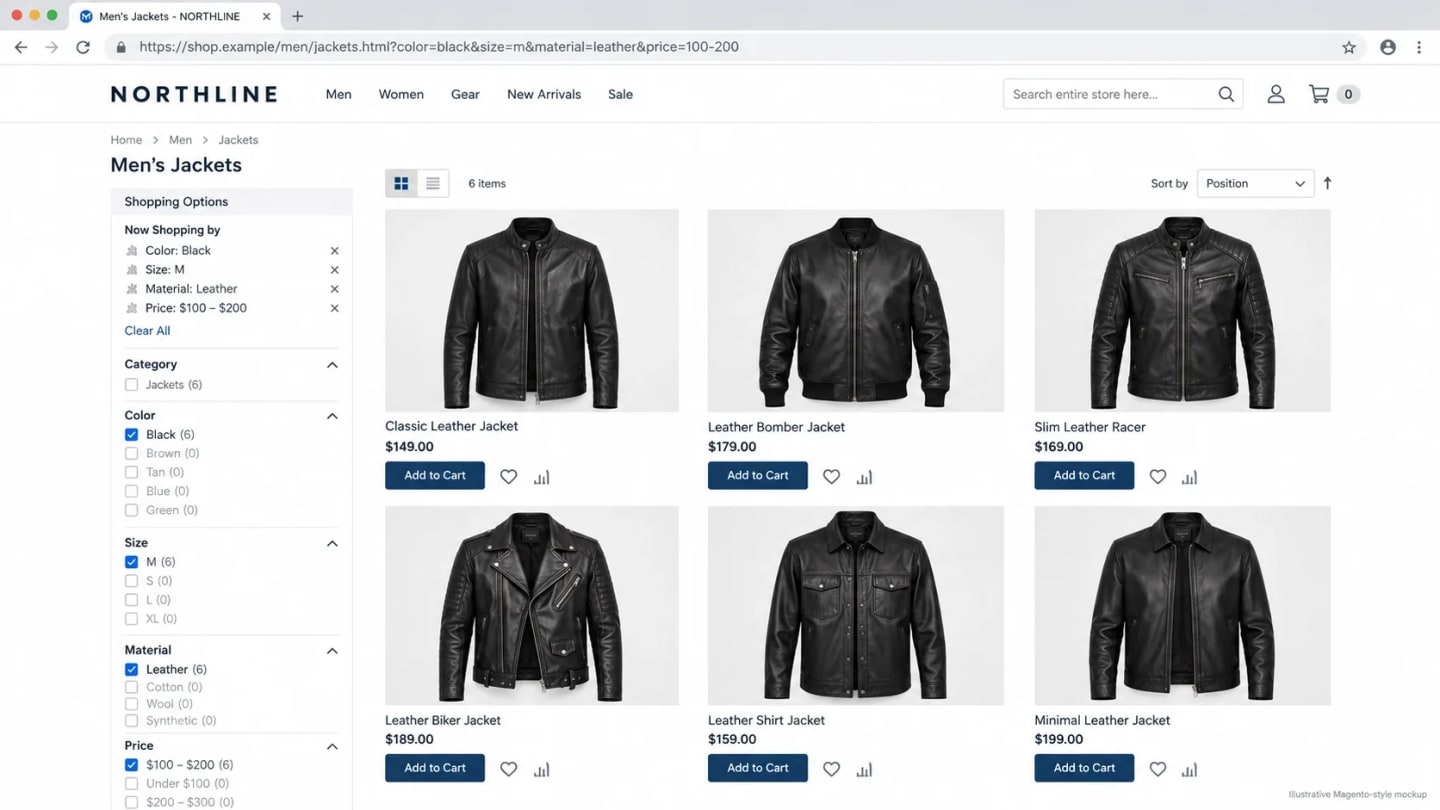
Google's crawl budget guide targets sites with 1 million or more pages changing weekly, or 10,000 or more changing daily. Shape beats size. A category with 30 colors, 12 sizes, 80 brands and 6 price bands has 30 x 12 x 80 x 6 = 172,800 filter combinations. Three such categories across four storefronts is 2,073,600 URLs. I do this arithmetic on the first call with any new client, because it turns a vague SEO worry into a number a CTO understands. Google warns that crawlers can't judge faceted URLs without fetching them.
These controls solve different problems, so don't swap them:
- txt manages crawling, not indexing. Google says a blocked URL can still appear in results, and noindex only works if the page isn't blocked, so Google can read it.
- Canonical consolidates signals. It's a hint, not a command, and it doesn't stop URL discovery.
- noindex,follow suits accessible filters that shouldn't rank. Monitor the crawl cost.
- PRG or JavaScript filters suit combinations with no search demand. See the PRG pattern.
- Static landing pages suit combinations with measurable demand, such as black abaya or gaming laptops under AED 3,000.
Handle sort orders, session IDs and pagination separately, and keep XML sitemaps to canonical, indexable 200 URLs. Platform reality differs:
- Adobe Commerce: configuration for canonicals and category paths, plus custom work for allowlisted landing pages.
- Shopify Plus: txt.liquid is a native template, root canonicals need Liquid changes, and routing is fixed. I've rewritten Liquid to force root canonicals for a GCC apparel brand, and the crawl shift showed up in the logs within weeks. The fixes are in our Shopify issues guide.
- SFCC: prefn and prefv refinement parameters need Business Manager configuration plus cartridge work.
- WooCommerce: filter_, orderby and add-to-cart parameters need a plugin or code.
- Headless: Filter state lives in your routing.
Monitor: segment logs into verified Googlebot Smartphone, other verified crawlers, SEO tools, identifiable AI crawlers and unknown bots, and verify by reverse DNS, never the user-agent alone. When I pull logs for a catalog like this, the pattern is almost always the same: a big share of Googlebot hits land on parameter URLs while new products wait days for a first crawl.
Phase 2: GCC Localization, Hreflang, and Multi-Currency Routing
No storefront structure wins universally. Subdirectories (/ae-en/, /sa-ar/) share authority and simplify sitemaps, but share fate. Country domains (.ae, .sa) separate pricing and entities, but you build authority twice. Separate storefronts on one PIM give regional teams autonomy, but cross-platform hreflang and duplicate feeds raise TCO.
The mistake I see most in GCC rollouts is a Saudi storefront launched as a copy of the UAE one with SAR swapped in. Decide on catalog overlap, legal entities, regional pricing, fulfilment differences, engineering maturity and team autonomy. VAT matters too: the UAE charges 5% and Saudi Arabia 15%, so tax-inclusive prices differ by market. Platforms vary: Shopify Markets uses language-country subfolders on secondary markets with automatic hreflang, while Adobe store views, SFCC sites and WooCommerce multisite need configuration or custom hreflang, and headless routing is fully custom.
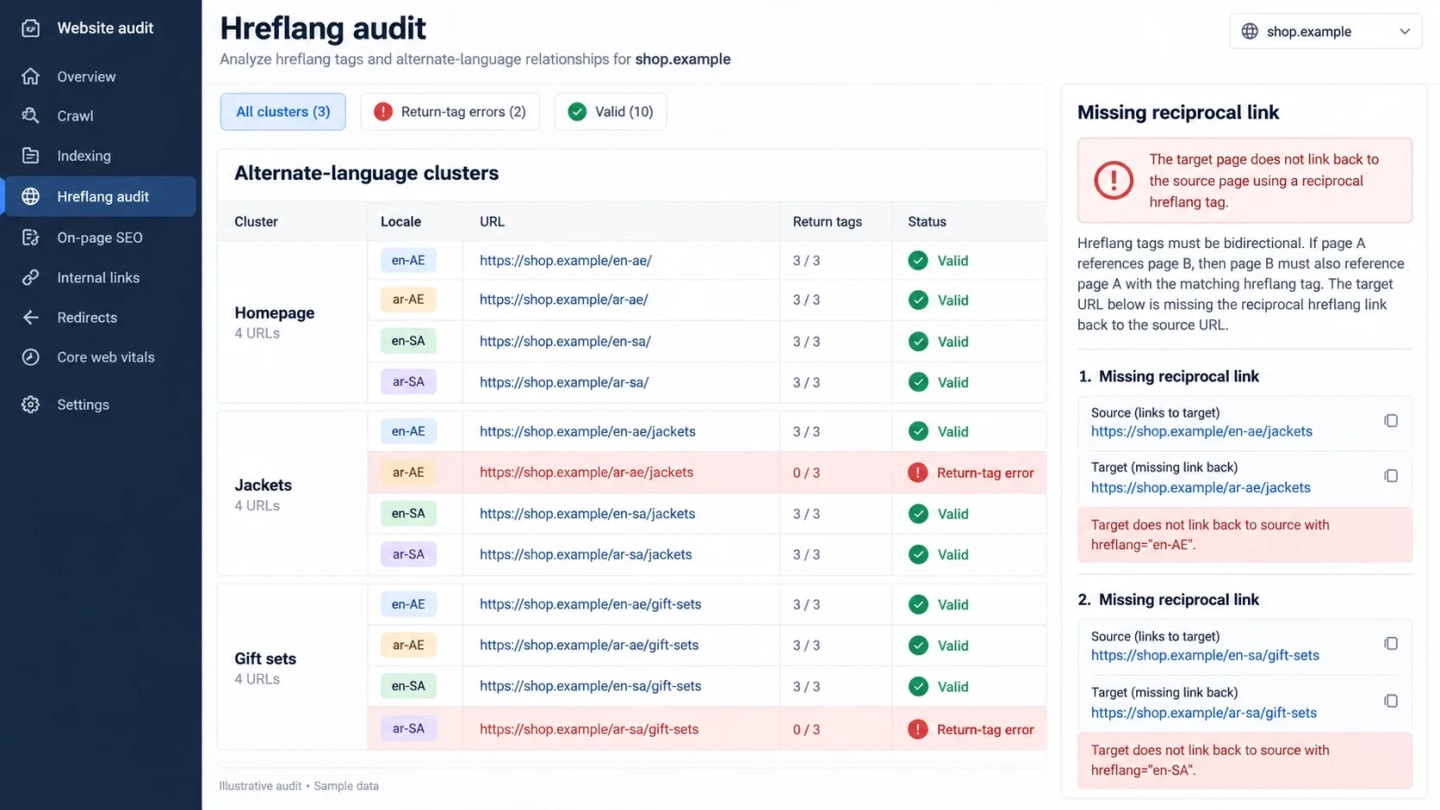
Distinguish URL labels from values. Hreflang uses language then region, so /ae-ar/ is a folder and ar-AE is the value. At scale, put annotations in XML sitemaps. Our own site declares en-AE, ar-AE and x-default that way.
Arabic is architecture, not translation. Serve Arabic server-rendered, on stable URLs, with lang="ar", dir="rtl" and self-referencing canonicals. Translating only titles leaves specifications, reviews, FAQs, variant labels, breadcrumbs, alt text and schema in English, which contradicts the page. Queries vary: Modern Standard Arabic (حاسوب محمول), Gulf commercial phrasing and loanwords (لابتوب) all coexist, and users mix scripts. Interface strings such as أضف إلى السلة, متوفر, غير متوفر and التوصيل إلى دبي should come from linguistic QA, not machine translation. Real Arabic SEO needs localized merchandising too.
Never auto-redirect by IP. Google says its default crawler IPs appear US-based, so locale-adaptive sites may go partly unindexed. I've watched a redirect rule built to help Saudi shoppers quietly hide an entire Arabic storefront from Google. Test RTL filters, variant selectors, price displays and checkout validation. Monitor hreflang return-tag errors and Arabic-to-English catalog parity.
Phase 3: ERP, Payment, and Logistics API Integrations
If your Odoo or SAP integration is constantly changing product URLs based on warehouse availability, rankings erode. The pattern: stock hits zero, the connector unpublishes the product, the URL returns 404, stock returns, and it flips back to 200. I've traced this exact flip on an Odoo integration, and the fix wasn't an SEO tag at all. It was changing which system was allowed to unpublish a product. Product identity, sellability and fulfilment status are separate entities. Treat every ERP, PIM, OMS, payment and logistics integration as SEO infrastructure with a written contract covering:
- Which system owns the URL, canonical, title, description, price, availability and variant state.
- What happens on an API timeout, and whether stale inventory beats an empty or deleted response.
- Which status code partial failures return, and how discontinued differs from temporarily unavailable.
- How redirects are tested, caches invalidated, and retries and rate limits handled.
- Who approves bulk URL, taxonomy or availability changes, and which alerts fire on sudden 404s, 5xx errors or soft 404s.
Logistics and payments leak too. DHL or Aramex plugins that append ?tracking_id=, and Tabby or Tamara return, failed-session and callback URLs, create thin pages. Disallow parameters on indexable URLs, and send noindex headers on standalone tracking and payment pages that users must load.
SUPPLY-CHAIN RESILIENCE
Since late February 2026, regional conflict has disrupted Gulf shipping. Gulf News reports war-risk surcharges can add $1,500 to $4,000 per container, Freightos says Shanghai to Jebel Ali rates rose from under $2,000 to above $8,000 with 7 to 10 day waits at some UAE ports, and Al Jazeera reports sharply higher insurance. For your stack, that means delayed stock can flip thousands of SKUs unavailable at once, and rerouting changes ETAs, prices and fulfilment nodes.
Read the Gulf News retail analysis, Freightos rate data and Al Jazeera insurance reporting as volatility, not forecast. Build for it:
- Keep likely-to-return products on a stable 200 URL with accurate out-of-stock state, preserved content, updated Offer.availability, alternatives and internal links. Use 404 or 410 only for permanent removal with no replacement.
- Decouple URL existence from live warehouse stock, queue inventory updates so partial syncs can't publish contradictions, and fall back gracefully on ERP timeouts.
- Purge caches on critical price, stock and delivery changes, and load crisis banners without hurting LCP or CLS.
- Monitor status-code volatility, schema errors, feed disapprovals and stock mismatches, with a named incident owner and rollback procedure.

Phase 4: Headless SEO, JavaScript Rendering, and Edge Caching
Server-side rendering builds HTML per request, static generation builds it ahead of time, incremental regeneration refreshes it on a schedule, streaming sends it in chunks, and hydration then attaches JavaScript. Client-side rendering ships an empty shell. Title, meta description, canonical, robots directives, hreflang, primary copy, price, availability, breadcrumbs, links and structured data must all be in the initial HTML. Google calls dynamic rendering a workaround, not a long-term architecture.
When I audit a headless build, my first test is curl, not a browser. I fetch the raw HTML for a product URL and read it the way a crawler does. A storefront that looks fine in React or Vue can still deliver an incomplete DOM to crawlers and AI retrieval. Test raw responses and logs, not just screenshots.
Here is exactly how we configure the edge CDN for headless builds. Fastly's default cache key is URL plus Host, and unnecessary variants fragment the cache, so put locale and currency in the path, not cookies. Never cache logged-in B2B pricing, cart state or personalization in a shared cache. Cloudflare supports stale-while-revalidate and stale-if-error, and Fastly offers soft purges by surrogate key, so price and stock webhooks can refresh pages without a traffic cliff.
Cache-Control: public, s-maxage=300, stale-while-revalidate=86400, stale-if-error=86400
Surrogate-Key: product-ABY-1042 category-abayas market-ae
Monitor source-versus-rendered parity and purge latency.
Phase 5: Answer Engine Optimization (AEO) and Structured Data at Scale
Google said at I/O 2026 that AI Overviews serves over 2.5 billion monthly users, but no markup guarantees a citation. What you can control is consistency. Generate Product (or variant-aware ProductGroup), Offer, AggregateRating, Review, BreadcrumbList, Organization and WebSite markup from the PIM so it matches visible content and live data, as Google's merchant listing documentation expects.
- Use semantic HTML specification tables with stable attribute names, units and short values, and keep factual specifications separate from promotional copy.
- Use SKU, GTIN, MPN and brand IDs, and align Arabic and English entities without collapsing different regional offers.
- Write FAQs about real compatibility, delivery, warranty and sizing questions.
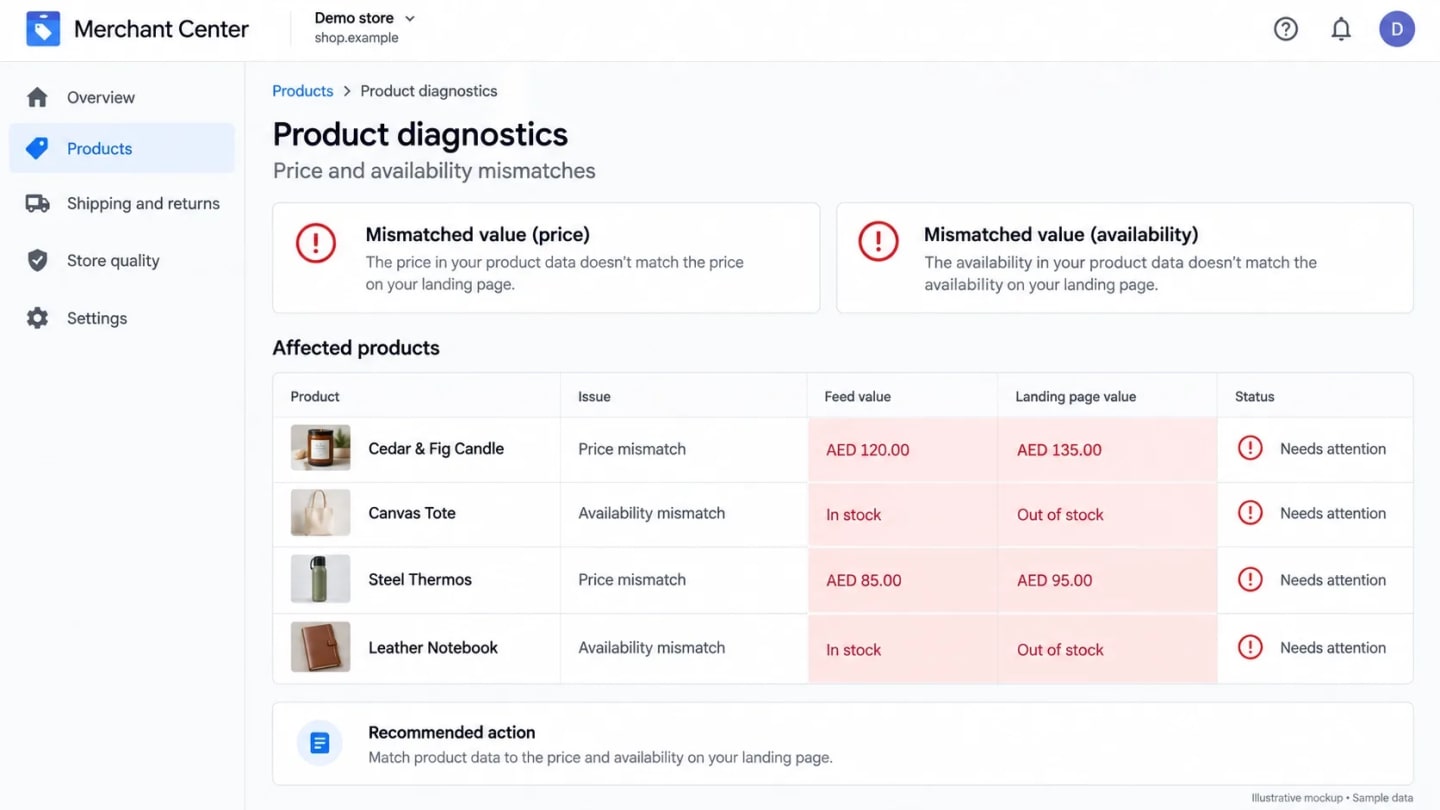
- Reconcile site, Merchant Center, Meta catalogs, PIM and ERP automatically. AED and SAR prices that disagree with schema will cause contradictions.
Clean tables, explicit labels, consistent identifiers and crawlable text make information easier to retrieve, which helps RAG systems, but they don't promise inclusion. Check access too: Google's AI features guidance ties eligibility to normal Googlebot controls, and OpenAI separates OAI-SearchBot from GPTBot. In our own UAE e-commerce case study, product schema with AED pricing was part of the fix that lifted non-branded top-10 keywords from 6 to 48 in 2025. Monitor schema errors and price mismatches.
Phase 6: Internal Site Search and Zero-Result Page Management
Internal search is an open door, and I've reviewed indexes where search results made up a surprising share of indexed URLs because nobody on the team owned the search template. Parameterized URLs (?q=, /search/), autocomplete endpoints and filters applied after a search create crawlable pages, and reflected terms in titles, headings and breadcrumbs let bots inject offensive, pharmaceutical, gambling, counterfeit or competitor queries into your index.
- Noindex search templates, keep them out of sitemaps, canonicals, related-search modules and indexable navigation, and avoid robots.txt as the only fix.
- Sanitize input, encode output, cap query length, rate-limit and apply WAF rules.
- Return a 404 for zero-result facet combinations, and show alternatives on zero-result searches.
- Mine search logs for demand, then build permanent editorial category pages instead of indexing raw results.
Monitor indexed search URLs and abusive-query spikes.
Phase 7: Core Web Vitals (CWV) and Frontend Performance optimization
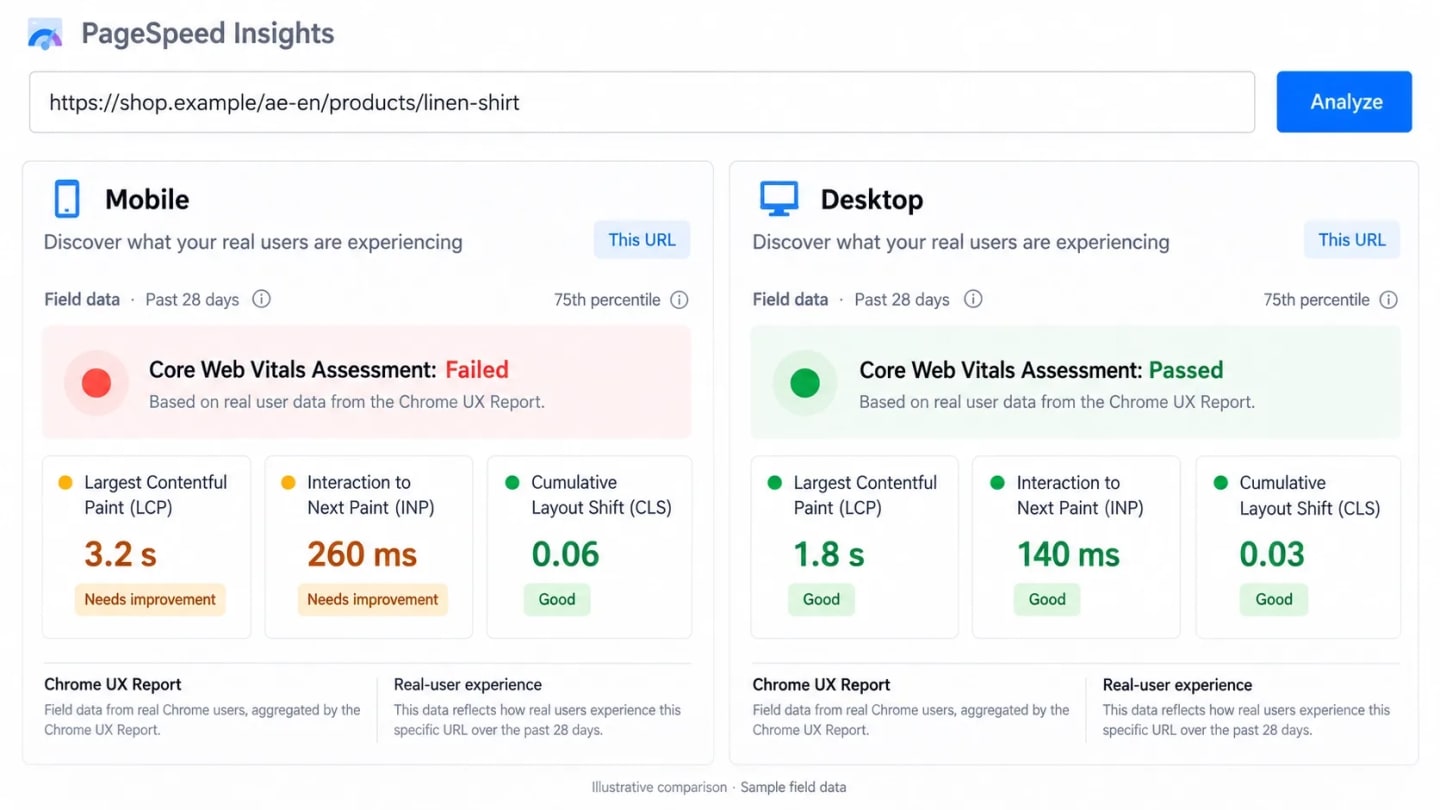
Use official thresholds only: LCP 2.5 seconds, INP 200 milliseconds, CLS 0.1. The Almanac's mobile data shows platform gaps: good CWV on 76% of Shopify origins, 35% of WooCommerce and 35% of Magento. A homepage pass doesn't make a catalog healthy, so measure by template, device, locale and geography, and separate lab diagnostics from field data.
- Size images responsively, serve AVIF or WebP, set fetch priority on the LCP asset and never lazy-load the hero.
- Subset Arabic and Latin fonts, limit Arabic weights and use careful preload with font-display.
- Cut hydration cost and long tasks, and audit app, tag-manager, chat, heatmap and BNPL scripts.
- Give every third-party script an owner, purpose, consent category, load condition, cost and removal date.
Budget for real GCC mobile networks and Arabic font payloads, not an ideal Dubai office connection. On WooCommerce, cache queries and review High-Performance Order Storage before White Friday. I've watched a large WooCommerce store buckle under unoptimized database queries on White Friday, and the SEO team heard about it from the sales dashboard, not from monitoring.
Phase 8: Team SEO Governance, Workflows, and Content Velocity
If your internal marketing team has to wait on a developer ticket just to publish an SEO-optimized category page, your content velocity is already dead. But unrestricted access creates crawler traps. The most expensive delays I've seen weren't technical, they were approval queues. Governance is the middle path:
- RACI: allocate responsibility across SEO, engineering, DevOps, product, merchandising, Arabic content, analytics, CRM, legal and ERP teams.
- Sprint criteria and tests: add SEO acceptance criteria to Jira, and automate pre-deployment checks for canonicals, hreflang, robots, schema, status codes and rendered HTML.
- Environments: block staging from indexing without letting that noindex reach production.
- Incidents: define severity levels, release gates, rollback criteria and named owners.
- Content model: let approved marketers build category and campaign pages without a deployment, while canonical, routing and schema rules stay protected.
Campaign pages need lifecycle rules. For Ramadan, Eid, White Friday and the Dubai Shopping Festival, reuse a stable evergreen hub, update dates and offers without changing the URL, strip expired claims immediately, keep UTM and preview variants out of the index, and redirect retired pages to the closest relevant destination, not the homepage.
True TCO includes licences, hosting, developer dependency, extension upkeep, regression testing, incident response and revenue lost to slow publishing. A dedicated technical SEO owner ties these to revenue

Phase 9: End-User UX, Checkout Friction, and Behavioral SEO Signals
Dwell time and bounce rate aren't confirmed ranking factors, so don't sell UX fixes internally as a ranking lever. UX earns its place because it converts expensive organic sessions, supports repeat visits and protects brand demand. Baymard's studies average 70.22% cart abandonment, with better checkout design lifting conversion by 35.26% for the average large site (September 2025 update).
- Test filters in LTR and RTL on mobile, and offer guest checkout.
- Fix address entry for apartments, villas, landmarks and Saudi formats, and validate UAE and KSA phone numbers.
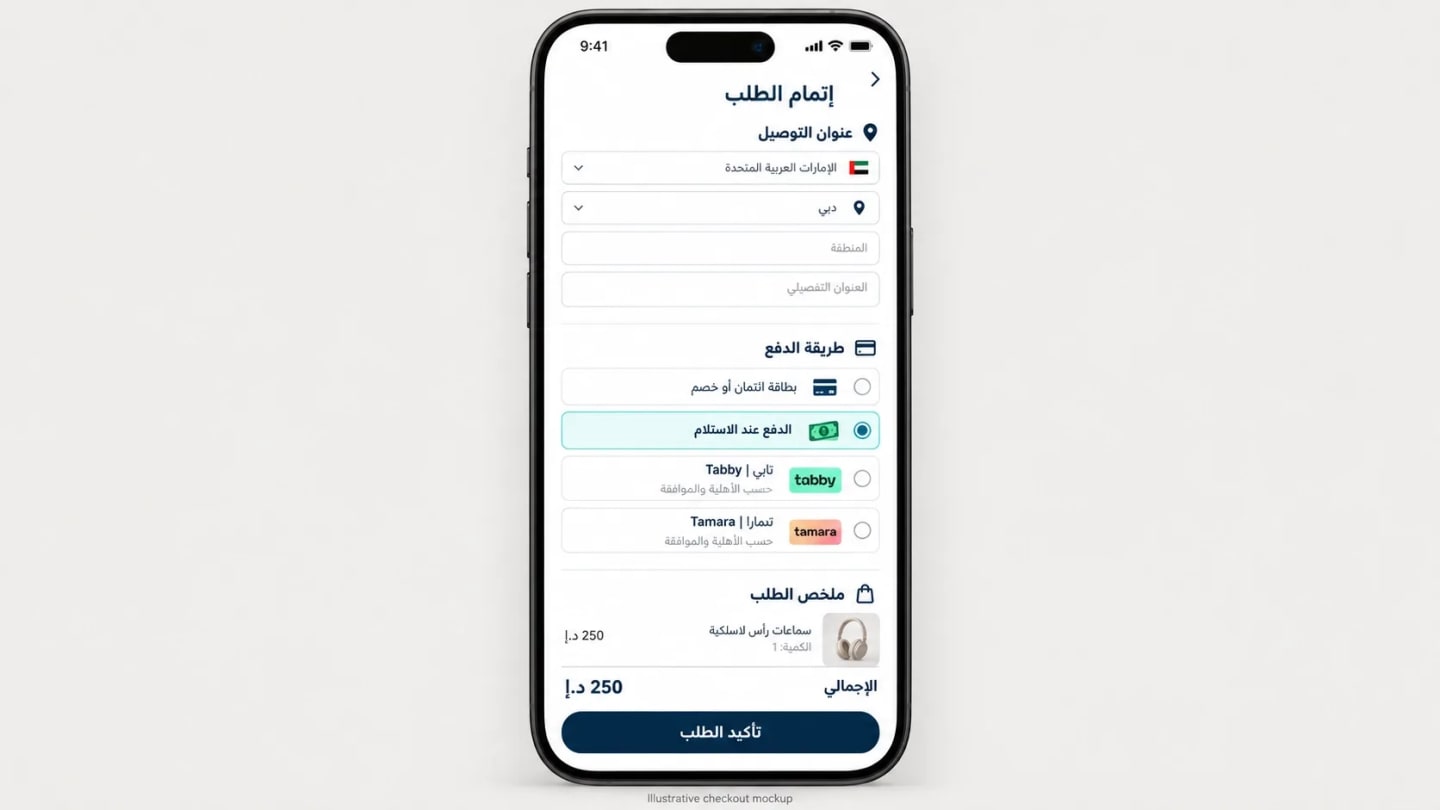
- Show VAT-inclusive prices clearly, delivery dates by emirate, cash-on-delivery eligibility and fees, and BNPL eligibility.
- Support Apple Pay, Shop Pay and local cards with payment-failure recovery, and show Arabic error messages.
- Preserve carts across locale changes, and never dump a language switch onto the homepage.
Keep cart, account, checkout and failed-payment URLs out of the index. Tabby publishes plugins for Shopify, Magento 2, WooCommerce and Salesforce, and each adds scripts and callbacks, so deduplicate analytics when users return from a gateway and preserve landing-page context through checkout. Monitor organic landing-page conversion.
The "Out of the Box" Platform Lies You Need to Ignore
Every one of these has come up in a kickoff call I've sat in.
- "The platform generates canonicals, so duplication is solved." Canonicals are hints. Believing this leaves crawlers fetching millions of duplicates.
- "Google renders JavaScript, so CSR is safe." Rendering is delayed and incomplete. You ship thin HTML to every other crawler.
- "Shopify Plus removes duplicate URL risks." It doesn't change routing. Duplicates survive.
- "Magento handles multilingual SEO automatically." Store views don't write hreflang. Clusters break silently.
- "A translation app is a GCC strategy." Apps translate strings, not intent. You get indexable Arabic pages nobody wants.
- "A robots.txt block keeps URLs out of search." It doesn't. Blocked URLs still surface without descriptions.
- "Out-of-stock products should always be deleted." Deletion erases ranking history and kills restock demand.
- "Schema guarantees AI citations." It doesn't, as our guide to getting cited Teams over-invest in markup, under-invest in data quality.
- "The ERP is backend-only." It's the biggest URL-change engine you own.
- "A CDN fixes Core Web Vitals, and headless is automatically faster." Neither fixes heavy scripts or poor hydration.
- "More apps are cheaper than custom development." Each app adds scripts, upgrades and conflicts, and the bill arrives as lost speed.
- "Marketing access is risky, so every metadata change needs a developer." That's how a Ramadan page ships after Ramadan.
- "A passing homepage score means a healthy catalog." Product and category templates fail separately.
FAQs
Which e-commerce platform requires the most technical SEO maintenance in the UAE?
Whichever one your team governs least. Magento and WooCommerce demand the most configuration and hosting discipline, while Shopify needs routing and app governance. Headless needs engineering ownership of every SEO element.
How do I stop Google from indexing my faceted search filters?
Choose per filter type: robots.txt to cut crawling, noindex,follow for accessible filters, and static pages for filters with demand. Don't combine a robots block with a noindex you need Google to read.
Can integrating Odoo or SAP hurt my e-commerce SEO?
Yes, when it controls URLs or publish state. Let the PIM own slugs, let the ERP change availability rather than existence, and alert on every status flip.
Does Shopify Plus fix the standard Shopify duplicate URL issues?
No. Plus doesn't change the routing, so collection-path duplicates remain. Strip them from internal links and force root canonicals in Liquid.
Are forced IP redirects for UAE and KSA users bad for SEO?
Yes. Google's default crawler IPs appear US-based, so redirected locales may never be crawled. Use visible switchers and a dismissible banner.
Why are my DHL/Aramex tracking URLs showing up in Google Search?
A plugin appends parameters to indexable pages, or standalone tracking pages are linked. Remove links, Disallow the parameter and add a noindex header to pages users must load.
How do I prepare a massive e-commerce catalog for Google SGE and ChatGPT?
Server-render pages, allow Googlebot and OAI-SearchBot, and keep markup, feeds and ERP data reconciled. Add semantic spec tables, but expect no guaranteed citation.
How does checkout friction impact my organic SEO rankings?
Not directly. Checkout friction isn't a ranking factor, but it cuts revenue per organic visit, so fix address, payment and RTL friction first.
Should out-of-stock products return a 404 status?
Not when restocking is likely. Keep a 200 page with accurate availability markup and alternatives, and use 404 or 410 only for permanent removal.
Should Arabic and English products use the same canonical URL?
No. Each language version canonicalizes to itself and connects through hreflang. A shared canonical tells Google to drop one.
More articles you might like
 Ecommerce
 Kashaf Khan
Common Shopify SEO Issues in the UAE and How to Fix Them
Discover 12 common Shopify SEO issues in the UAE and learn practical ways to fix them, improve rankings, attract local shoppers, and grow your online store.
 SEOKashaf Khan
How to Get Your Dubai Business Cited in Google AI Overviews and ChatGPT
Learn how to get your Dubai business cited in Google AI Overviews and ChatGPT with practical steps to improve content, credibility, and AI search visibility.
 Social MediaKashaf Khan
90+ Eid Al Etihad Social Media Captions and Post Ideas for UAE Businesses
Explore 90+ Eid Al Etihad social media captions and post ideas to engage audiences and inspire UAE businesses.