
QUICK ANSWER
Shopify's rigid architecture creates specific technical bottlenecks: duplicate product URL structures, uncontrolled faceted navigation parameters, and app bloat that wastes crawl budget. In the UAE, this gets worse fast, because you're running multi-currency and bilingual /en and /ar setups on top of it, alongside local payment gateway leaks and missing structured data that Answer Engines need to cite you. Fixing it takes hands-on Liquid theme work, strict canonical enforcement, dynamic hreflang mapping, and product data structured for Retrieval-Augmented Generation (RAG), not another SEO app.
Most Shopify store owners in Dubai rely on generic SEO apps that slow down their site without fixing the underlying Liquid code issues.
That's the pattern I keep finding on audits: a store paying for three overlapping optimization apps while its actual product URLs sit duplicated four ways. The UAE ecommerce market reached USD 12.30 billion in 2026, growing at an 11.29% CAGR, and every one of those dirhams is chasing the same finite pool of Shopify stores. Despite regional supply chain pressure elsewhere in the Middle East, UAE ecommerce keeps compounding, driven by mobile-first shopping, Tabby and Tamara at checkout, and same-day fulfillment hubs in Dubai and Sharjah.
Competition among Shopify stores in Dubai and Abu Dhabi has never been tighter. Organic search and Answer Engine visibility across ChatGPT, Perplexity and Google's AI Overviews aren't optional add-ons anymore. They're the highest-ROI defense you have against a rising cost of paid acquisition. Most of what follows sits under the umbrella of dedicated ecommerce SEO work rather than generic content SEO, because a Shopify catalog behaves nothing like a blog. This guide covers twelve issues I see on nearly every UAE Shopify audit, the exact Liquid-level fix for each, and how to structure your catalog so AI answer engines actually recommend your store instead of a competitor's.
None of this is theoretical. I've pulled a UAE fashion store out of a canonical loop that had Google indexing three thousand filtered collection URLs instead of the forty category pages that actually mattered, and watched crawl stats normalize within a month once the fix shipped. I've rebuilt hreflang for a Dubai and Riyadh dual-market store where the Arabic version had been invisible to Google for over a year because of a single self-referencing canonical tag nobody had caught.
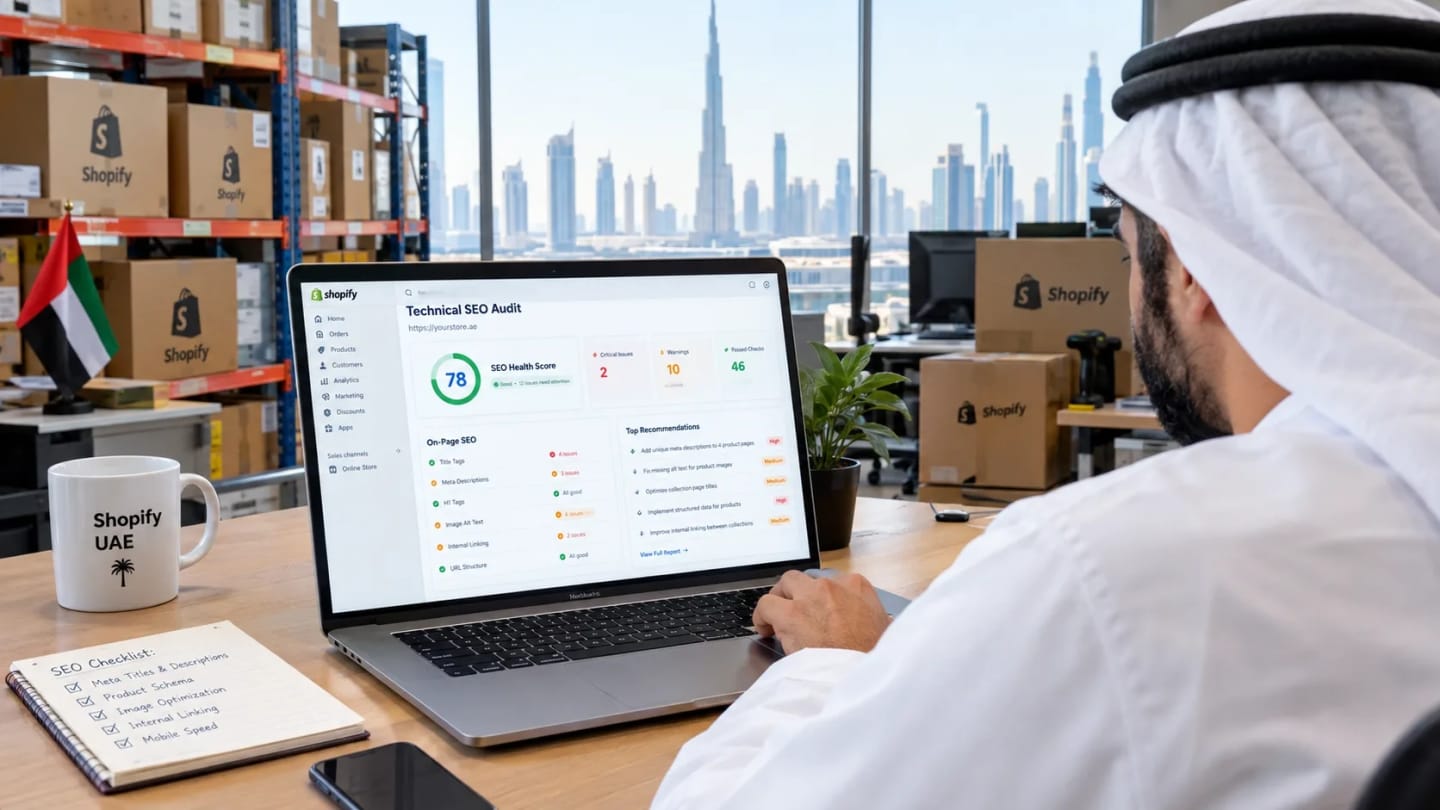
UAE E-Commerce in 2026: Resilience, Growth, and Technical Demands
Here's the reality. Regional headlines talk about geopolitical tension and shifting global supply chains. Underneath that noise, UAE ecommerce keeps growing, because the fundamentals don't care about headlines: high mobile penetration, mature digital payment rails, and fulfillment infrastructure that gets a parcel from a Jebel Ali warehouse to a Dubai Marina apartment same day.
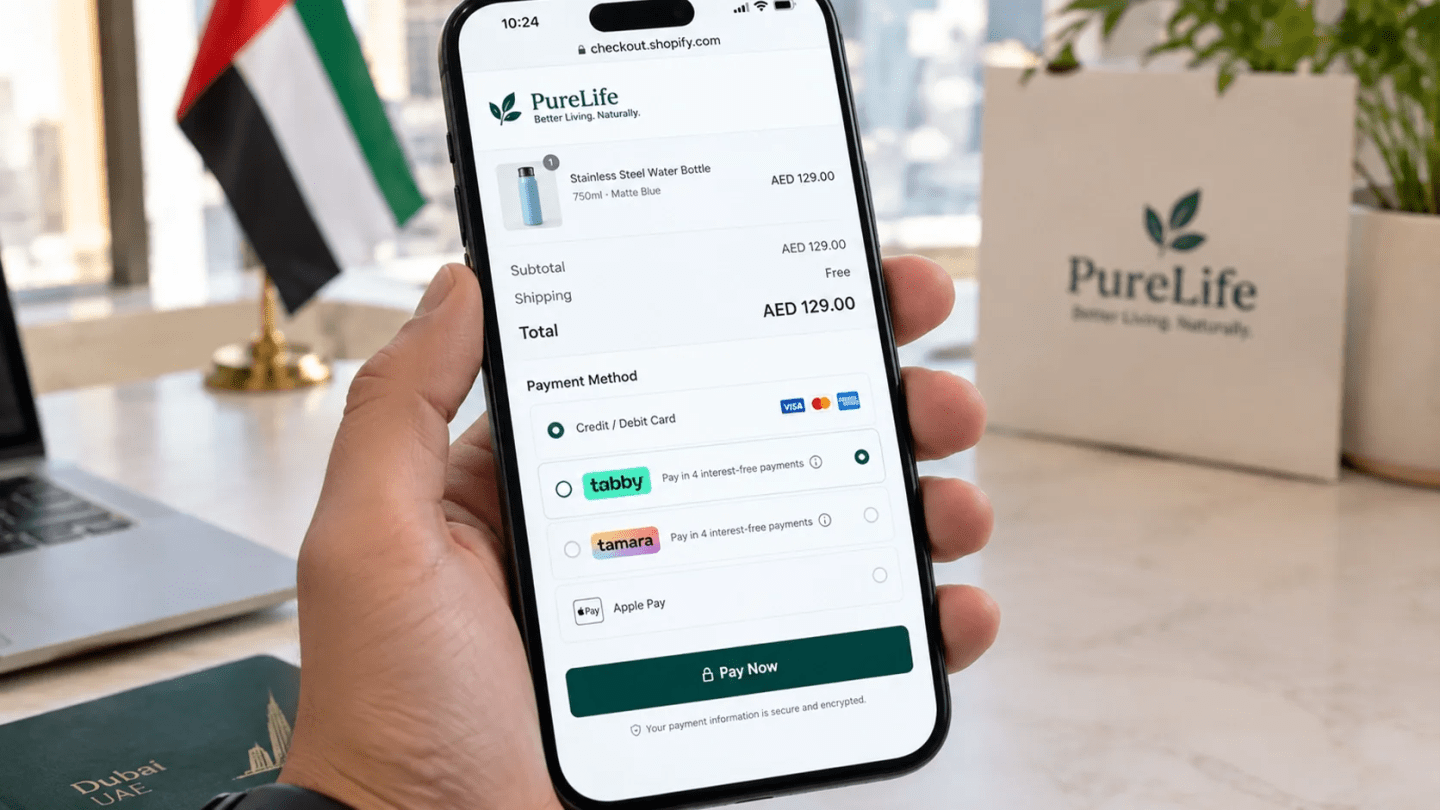
Buy-now-pay-later is a big part of why. Etihad Credit Bureau began including Tabby and Tamara transaction data in UAE credit reports from July 2026, which tells you how mainstream BNPL has become at UAE checkouts. If your Shopify store's payment gateway integrations are leaking staging URLs or confirmation parameters into Google's index (Issue 10 below), you're handing competitors a technical advantage for free.
Look at the acquisition math. Paid ad costs across the GCC keep climbing as more brands compete for the same Instagram and Google Ads inventory. Organic and AI-cited visibility is the only channel where your cost per acquisition doesn't rise every quarter. That's why partnering with an experienced SEO agency in UAE is critical when refactoring Shopify Liquid code for multilingual, multi-currency targets. Generic global SEO advice doesn't account for hreflang between /en and /ar, or for AED and SAR running through the same theme.
12 Common Shopify SEO Issues and Fixes at a Glance
| # | Issue | Root cause | Primary fix |
|---|---|---|---|
| 1 | Duplicate product URLs | Collection-aware paths alongside canonical paths | Enforce canonical tags, strip collection context from internal links |
| 2 | /en and /ar misconfiguration | Missing or self-referential hreflang, IP redirects | Dynamic hreflang mapping, remove crawler-blocking redirects |
| 3 | Multi-currency parameter bloat | Shopify Markets appends ?currency= params |
Canonicalize to the base currency URL |
| 4 | Faceted navigation bloat | Tag filters generate near-infinite URL combinations | Noindex via metafield, robots.txt.liquid rules |
| 5 | App script bloat (LCP/INP) | Render-blocking JS from stacked apps | Defer scripts, content_for_header cleanup |
| 6 | Thin schema JSON-LD | Shopify's default microdata is minimal | Custom nested Product, Offer, AggregateRating schema |
| 7 | Rigid XML sitemap | Auto-generated sitemap can't exclude low-value pages | Metafield noindex,follow on tag and policy pages |
| 8 | Image CDN and alt text gaps | Missing dimensions, no Arabic alt attributes | Explicit aspect ratios, bilingual descriptive alt text |
| 9 | Poor out-of-stock handling | Deleted PDPs return hard 404s | 410 or 301 to category hub, OutOfStock schema |
| 10 | Payment gateway leakage | Confirmation URLs and params get crawled | robots.txt.liquid disallow on checkout paths |
| 11 | Missing Arabic transliteration | Content written for MSA only, not Gulf dialect | Multi-script keyword mapping and native copy |
| 12 | Unstructured product data for RAG | Specs buried in prose, no Q&A format | Markdown tables, direct answer blocks, semantic microdata |
Common Shopify SEO Issues and How to Fix Them in the UAE
1. Duplicate Product URLs Created by Collection Handles
Issue: Shopify links products through both the canonical /products/handle path and a "collection-aware" /collections/x/products/handle path. If your theme links internally through the collection version everywhere, Google indexes the same product under several URLs instead of one.
Fix: Strip the | within: collection filter from product-grid-item.liquid, related-products.liquid and any custom search template so links always resolve to the bare /products/ path, then confirm canonical_url isn't inheriting collection context.
|
{% comment %} Before: forces the collection-aware path {% endcomment %} <a href="{{ product.url | within: collection }}">
{% comment %} After: always links the canonical product URL {% endcomment %} <a href="{{ product.url }}"> |
Verify with a site: search restricted to /collections//products/ once the fix ships, and watch Google Search Console's canonical documentation reporting drop over the following weeks.
2. Multilingual Misconfigurations Between English (/en) and Arabic (/ar)
Issue: Hreflang tags point to the wrong locale, the Arabic page's canonical self-references back to English, or a geolocation app IP-redirects Googlebot before it ever reaches the alternate version, so Google indexes only one language.
Fix: Rebuild hreflang so /en and /ar point to each other with correct locale codes and an x-default fallback, confirm each page canonicals to itself, and whitelist crawler user agents in your redirect app.
|
<link rel="alternate" hreflang="en-ae" href="https://example.ae/en/products/black-abaya" /> <link rel="alternate" hreflang="ar-ae" href="https://example.ae/ar/products/black-abaya" /> <link rel="alternate" hreflang="x-default" href="https://example.ae/en/products/black-abaya" /> |
Google's own hreflang implementation guidance is worth reading line by line, since most Shopify apps generate ninety percent of this correctly and silently break the self-referencing tag.
3. Multi-Currency Parameter Crawl Bloat (AED, SAR, KWD)
Issue: Shopify Markets appends a currency parameter (?currency=AED, ?currency=SAR, ?currency=KWD) to URLs, and an unstripped canonical tag lets Google index a separate page per currency variant of the same product.
Fix: Keep canonical_url resolving to the base URL with no query string, regardless of currency, while still rendering the correct localized price client-side.
Check Search Console's Page Indexing report for "Duplicate, Google chose different canonical" flags on your top products. That flag is almost always a currency or variant parameter leaking through.
4. Uncontrolled Faceted Navigation and Filter Tag Indexation
Issue: Tag filters generate a near-infinite combination of URLs across size, color and price, and on a catalog of a few hundred SKUs that can multiply into tens of thousands of near-duplicate pages burning crawl budget.
Fix: Apply noindex,follow to any collection URL with more than one active filter parameter, and block the worst combinations outright in robots.txt.liquid.
|
{% comment %} robots.txt.liquid {% endcomment %} User-agent: * Disallow: /collections/*+* Disallow: /collections/*%2B*
Sitemap: {{ shop.url }}/sitemap.xml |
5. App Script Bloat Degrading LCP and Interaction to Next Paint (INP)
Issue: Stacked apps each inject their own render-blocking script. Shopify's own data shows poor-performing apps cut conversion by roughly 0.29 percentage points each, and HTTP Archive's Chrome UX Report shows just over half of all origins passing Core Web Vitals.
Fix: Audit content_for_header for every script an app injected, defer what isn't needed above the fold, and delete apps costing more in LCP and INP than they add in revenue. A technical SEO audit will show you which app is which.
Fast triage: open Chrome DevTools' Network tab on your slowest product page, sort by size, and match every file over 50KB back to the app that injected it.
6. Incomplete Local Business and Product Schema JSON-LD for UAE Knowledge Graphs
Issue: Shopify's default microdata skips AggregateRating, MerchantReturnPolicy and UAE-specific delivery and currency details that answer engines use to decide whether to trust and cite your listing.
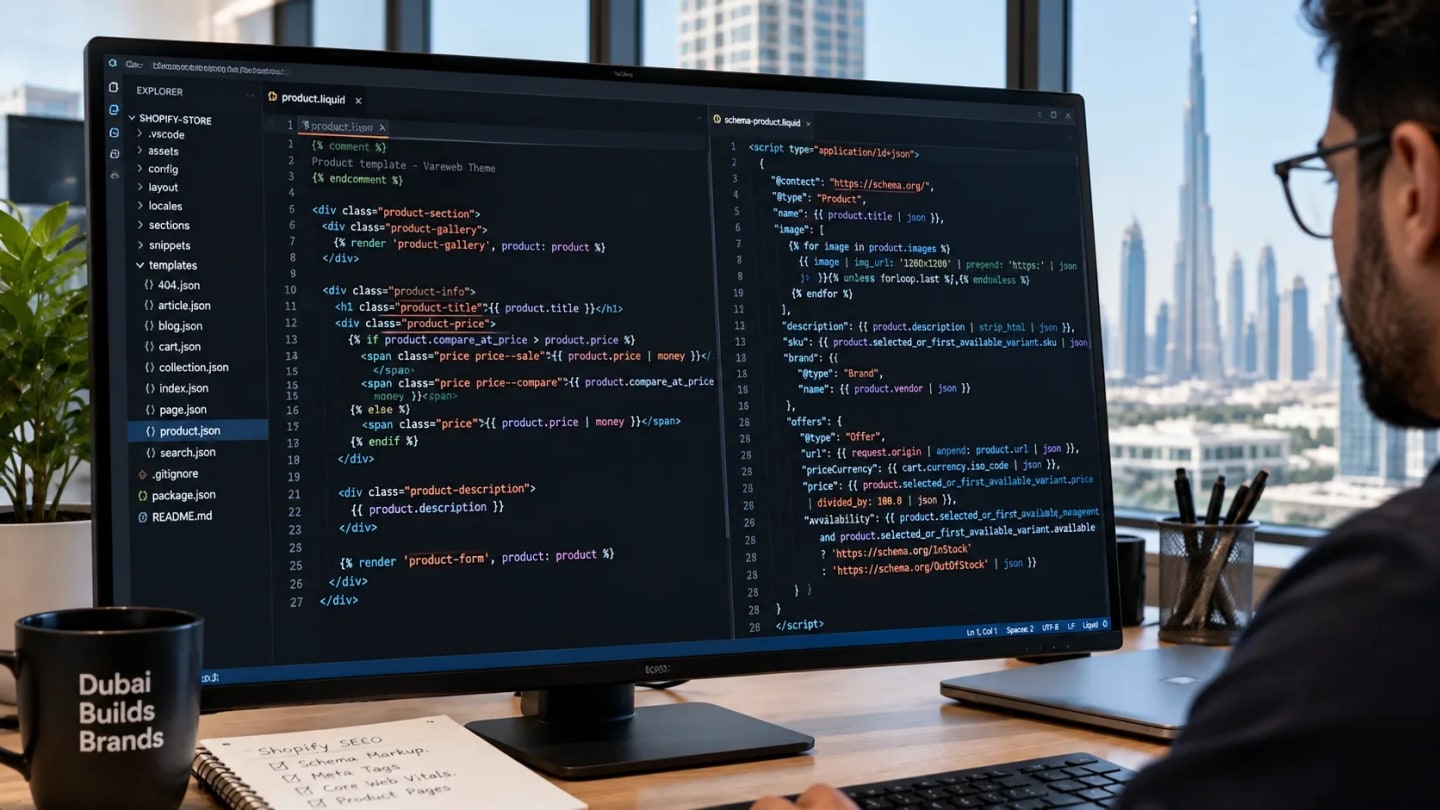
Fix: Inject custom nested JSON-LD for Product, Offer, AggregateRating and MerchantReturnPolicy with real AED pricing and delivery zones, validated against schema.org's Product specification.
|
{ "@context": "https://schema.org", "@type": "Product", "name": "Black Abaya - Dubai Collection", "offers": { "@type": "Offer", "priceCurrency": "AED", "price": "349", "availability": "https://schema.org/InStock", "hasMerchantReturnPolicy": { "@type": "MerchantReturnPolicy", "applicableCountry": "AE", "returnPolicyCategory": "https://schema.org/MerchantReturnFiniteReturnWindow", "merchantReturnDays": 14 } }, "aggregateRating": { "@type": "AggregateRating", "ratingValue": "4.7", "reviewCount": "82" } } |
7. Rigid XML Sitemap Structure and Indexation of Low-Value Pages
Issue: Shopify auto-generates and locks sitemap.xml, so low-value pages like tag filters, search results and policy pages can't be excluded from it directly.
Fix: Apply Shopify's own metafield-based noindex to those templates, so they stay crawlable and keep passing link equity while staying out of the index.
8. Image CDN Compression Failures and Missing Arabic Alt Text
Issue: Missing width and height attributes cause layout shift on slow-loading hero images, and Arabic pages often inherit English-only alt text, losing visual search and AEO surface for Gulf Arabic queries.
Fix: Declare explicit aspect ratios on every image, and write native, descriptive Arabic alt text for every /ar page rather than a machine translation of the English version.
9. Poor Handling of Out-of-Stock and Discontinued Season Products
Issue: Deleting a sold-out product page the moment it sells out throws away its backlinks, rankings and search equity, which is especially costly during fast-moving UAE seasons like Ramadan and Eid.
Fix: Use a 410 for permanently discontinued products, a 301 to the closest category for seasonal stockouts, and update the product's schema to OutOfStock instead of removing the page.
- Hard 404: only for genuine mistakes or spam pages. The equity is gone.
- 410 Gone: tells Google the removal is permanent, for products discontinued for good.
- 301 redirect: the right call for seasonal stockouts, routed to the closest category or a restock waitlist page with an email capture.
10. Indexation Leakage from Local Payment Gateways (Telr, Network International, Tabby, Tamara)
Issue: Tabby, Tamara, Telr and Network International redirect and confirmation URLs can get crawled and indexed if robots.txt doesn't explicitly block them, exposing live order data.
Fix: Add explicit Disallow rules in robots.txt.liquid for /checkouts/ and each provider's callback parameters, and run a quarterly site: search to catch leaks early.
|
{% comment %} robots.txt.liquid additions {% endcomment %} Disallow: /checkouts/ Disallow: /*?*tabby_ Disallow: /*?*tamara_ Disallow: /*?*telr_ |
الدفع عند الاستلام (cash on delivery) confirmation flows through your fulfillment partner's API deserve the same scrutiny as Tabby or Tamara. Don't assume BNPL is the only leak vector.
11. Missing Arabic Transliteration and Dialect Search Intent Mapping
Issue: UAE shoppers search across English, formal Modern Standard Arabic, and Gulf Arabic transliteration, and most stores write Arabic content only in formal MSA, missing most of the real search volume.
Fix: Run separate keyword research for each register and write native copy for each, treating Arabic SEO as its own project rather than a mirror of /en.
12. Unstructured Product Data Failing Retrieval-Augmented Generation (RAG) for AI Citations
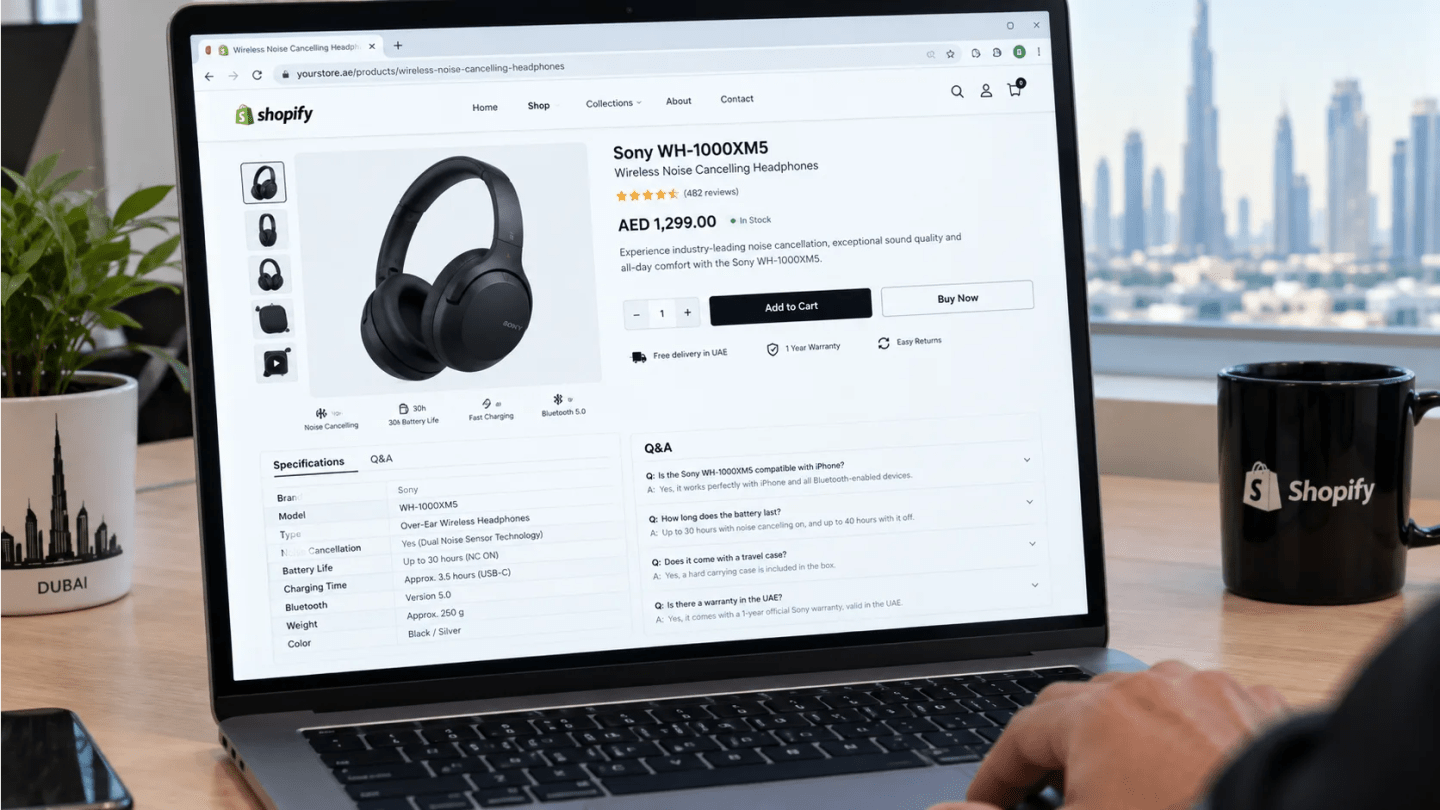
Issue: Product specs and policies buried in marketing prose don't extract cleanly for AI retrieval systems, so ChatGPT and Perplexity are more likely to skip or misquote your page than cite it directly.
Fix: Structure specs as Markdown tables and direct Q&A blocks, backed by the same facts in JSON-LD from Issue 6, so retrieval systems get one consistent, citable source.
|
EXAMPLE PRODUCT Q&A BLOCK Does this abaya run true to size? This abaya runs true to standard UAE sizing (S to XXL), and the model shown is 170cm wearing a size M. Free size exchanges are available within 14 days across Dubai, Abu Dhabi and Sharjah. |
Strategy for AEO and AI Answer Engine Visibility on Shopify
The hard truth is that a perfectly optimized Shopify store can still be invisible to ChatGPT if its crawlers can't reach the pages. Google said at I/O 2026 that AI Overviews now serves over 2.5 billion monthly users, with AI Mode passing one billion in its first year. SparkToro's 2026 analysis of Similarweb clickstream data found that 68.01% of U.S. Google searches ended without a click in early 2026. Whether or not that exact figure holds in the UAE, the direction is the same: fewer shoppers click through, more of them act on what the AI already told them.
For Shopify specifically, that means two things. First, Google's guidance on AI features and your website confirms that robots.txt directives for Googlebot are what control AI Overview eligibility, not a separate opt-in. Second, OpenAI's crawler documentation separates OAI-SearchBot, which decides ChatGPT search citations, from GPTBot, which is purely a training decision. Check your Shopify theme's robots.txt.liquid isn't accidentally blocking OAI-SearchBot while trying to opt out of training data collection.
Beyond crawl access, this is where Issue 12's work pays off directly: answer engine optimization for an ecommerce catalog is mostly about giving retrieval systems clean, extractable product facts instead of marketing copy dressed up as specifications.
Shopify App Stack Hygiene: What to Keep and What to Delete
Look at the code, not the app store rating. Every app on your store should earn its render-blocking script.
- Keep: apps that touch conversion directly and load asynchronously, BNPL widgets like Tabby and Tamara, review platforms with lazy-loaded embeds, and structured data apps that write clean JSON-LD rather than inline microdata.
- Audit quarterly: anything installed for a single campaign and never removed. Pop-up builders, countdown timers and referral widgets are the usual suspects still injecting scripts a year after the promotion ended.
- Delete: all-in-one "SEO booster" apps that promise to fix crawl issues through settings toggles alone. They rarely touch Liquid templates, which is where issues 1 through 9 above actually live.
The "Old SEO" Habits You Must Drop Immediately
Time to be brutal about what stopped working.
- Installing an all-in-one SEO app and calling it done. These apps handle meta tags. They don't touch canonical loops, faceted navigation, or app-injected render-blocking scripts, which is where the real damage happens.
- Keyword-stuffing collection descriptions. Repeating "best abaya Dubai UAE cheap abaya online" across every collection reads as spam to shoppers and gives an AI retrieval system nothing extractable to cite.
- Building empty collection pages for every long-tail variation. A "red abaya size large Dubai" collection with three products isn't a page, it's crawl budget waste with a URL attached.
How to Monitor Your Shopify AI Visibility and Technical Health
Google Search Console
Crawl Stats under Settings shows exactly how Googlebot is spending its time on your store. A sudden spike in crawl requests to /collections/+ paths is your faceted navigation problem showing up in the data, not a hypothetical one.
GA4
Build a custom channel group filtering Source against chatgpt.com, perplexity.ai and any AI Overview referral pattern you can isolate. Track it against organic separately, since AI-referred sessions often convert differently than classic search traffic.
Screaming Frog and custom crawlers
Set a custom user-agent to simulate Googlebot and OAI-SearchBot separately when crawling your own Liquid theme. Differences in what each crawler can see usually point straight at a JavaScript-rendered element or a firewall rule blocking one bot and not the other.
FAQs
Why does Shopify create duplicate URLs for products?
Because a product can live inside multiple collections, and Shopify generates a collection-aware path for each one alongside the canonical /products/ path. The canonical tag should consolidate these, but custom theme code that links the collection-aware path everywhere breaks that consolidation.
How do I fix Arabic and English hreflang issues on my UAE Shopify store?
Check that each language version's hreflang tag uses the correct locale code and that the Arabic page's canonical points to itself, not the English version. Then confirm no geolocation redirect app is blocking Googlebot from reaching the alternate language at all.
Will installing too many Shopify apps ruin my site's Google rankings?
Not directly, but the render-blocking scripts they inject will hurt your Core Web Vitals, and Google does use page experience signals. The bigger cost is usually conversion rate, which Shopify's own data ties to poorly performing apps stacking up.
How do I stop Shopify filter tags from being indexed by Google?
Apply a noindex,follow directive to filtered collection URLs once more than one filter parameter is active, and add a robots.txt.liquid rule blocking the worst combinatorial patterns outright.
Can I edit Shopify's robots.txt file to fix crawl budget issues?
Yes, through the robots.txt.liquid template, which lets you add custom Disallow rules on top of Shopify's defaults. It won't let you remove Shopify's own baseline rules, but it's enough to block faceted navigation and payment gateway paths.
How do I get my Shopify products recommended by ChatGPT and Perplexity?
Allow OAI-SearchBot in your robots.txt, structure product specs as extractable Markdown tables and direct Q&A blocks, and back it with complete JSON-LD including price, availability and return policy in AED.
Should I delete out-of-stock product pages on my Shopify store?
Only if the product is permanently discontinued, and even then a 410 or a 301 to a related category preserves more value than a hard 404. For seasonal UAE stock like Ramadan collections, redirect to the category hub and capture back-in-stock leads instead.
Why are my local UAE payment gateway URLs showing up in Google search results?
Your robots.txt likely isn't blocking checkout confirmation and redirect paths from Tabby, Tamara, Telr or Network International. Add explicit Disallow rules for those paths and check quarterly with a site: search against your own domain.
More articles you might like
 Ecommerce
 Kashaf Khan
The Technical SEO Checklist for Large-Scale E-Commerce Brands in the UAE
A practical technical SEO checklist for large UAE e-commerce brands, covering crawlability, indexing, site speed, product schema, and duplicate content.
 SEOKashaf Khan
How to Get Your Dubai Business Cited in Google AI Overviews and ChatGPT
Learn how to get your Dubai business cited in Google AI Overviews and ChatGPT with practical steps to improve content, credibility, and AI search visibility.
 Local SEOKashaf Khan
Eid Al Etihad Google Business Profile Checklist
Set Eid Al Etihad special hours, Offer posts and festive photos on your Google Business Profile before 2 December, without post rejections or suspensions.